Traditional paper bags are familiar, printable, and widely accepted. But they are not automatically the most sustainable option. Some use virgin fiber without traceable sourcing. Some are overbuilt for a light product. Some use coatings or finishes that complicate recycling. Some are too weak and get discarded after one short use.
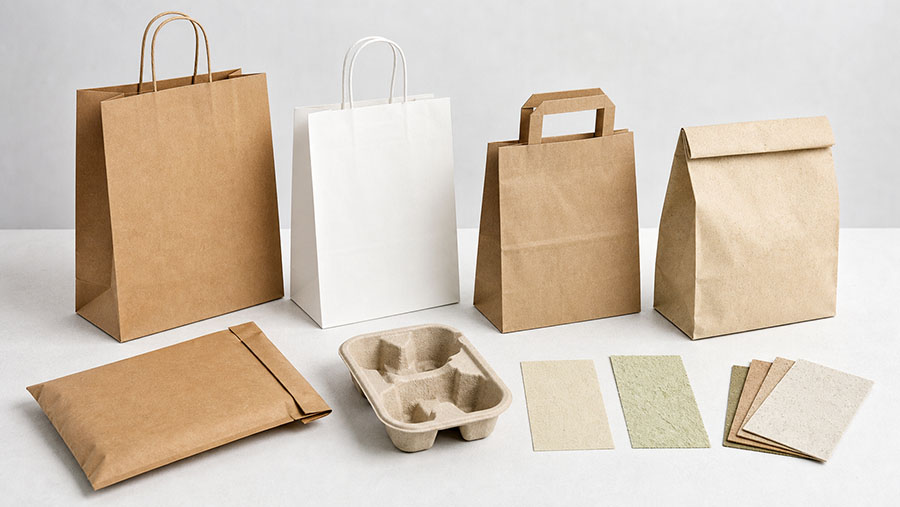
The best eco-friendly alternatives to traditional paper bags are recycled paper bags, FSC-certified paper bags, reusable paper bags, compostable paper bags, grass paper bags, bamboo paper bags, molded fiber packaging, paper courier bags, and plastic-free takeaway paper bags. The right choice depends on product weight, food contact needs, moisture exposure, printing, certification, cost, and local disposal systems.
For B2B buyers, the real question is not “Which material sounds green?”
The better question is: Which packaging can prove its claim and survive the actual use route?
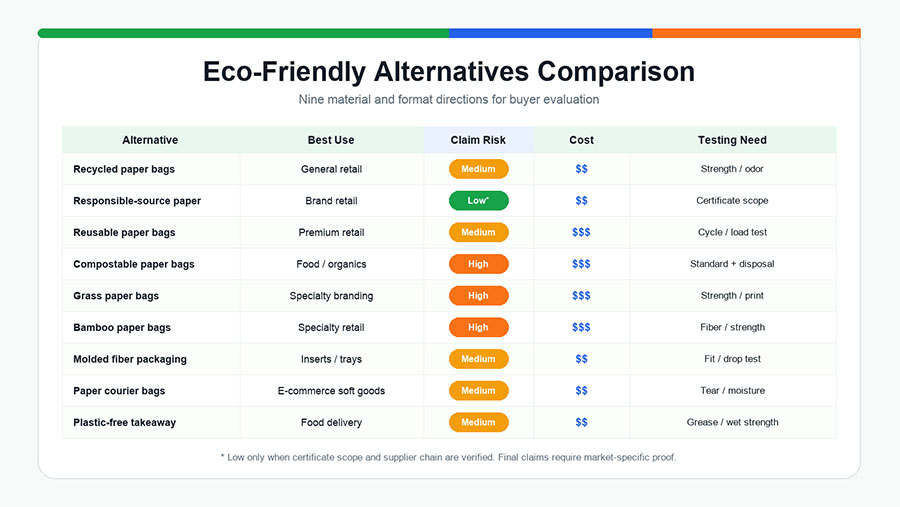
Quick Comparison: Eco-Friendly Paper Bag Alternatives
| Alternative | Best use case | Main advantage | Key limitation | Buyer check |
|---|---|---|---|---|
| Recycled paper bags | Retail, grocery, promotional bags | Reduces virgin fiber demand | Strength and print quality vary by grade | Recycled content documentation |
| FSC-certified paper bags | Retail, food, luxury, export packaging | Traceable responsible sourcing | Requires correct certification and label use | FSC certificate and claim scope |
| Reusable paper bags | Fashion, cosmetics, gifts, premium retail | More value if customers reuse them | Higher material and structure cost | Handle and bottom load testing |
| Kompostlanabilir kağıt torbalar | Food scraps, produce, selected foodservice | Supports composting where infrastructure exists | Coatings and inks may affect compostability | EN 13432 / ASTM D6400 or local certification |
| Grass paper bags | Natural retail, organic brands, dry goods | Distinctive texture and fiber story | Availability and performance vary | Fiber mix, strength, printability |
| Bamboo paper bags | Premium eco brands, gift, cosmetic, dry food | Renewable fiber positioning | Cost and supply chain must be verified | Source, certification, and sample testing |
| Molded fiber packaging | Inserts, trays, protective packaging | Replaces some plastic or foam structures | Not a direct shopping bag replacement | Mold cost and product fit |
| Paper courier bags | Apparel, soft goods, documents, e-commerce | Plastic mailer reduction | Moisture and tear resistance need testing | Seal, tear strip, transport simulation |
| Plastic-free takeaway paper bags | Restaurants, cafes, bakery, delivery | Reduces plastic components | Steam, grease, and handling stress | Food contact and barrier performance |
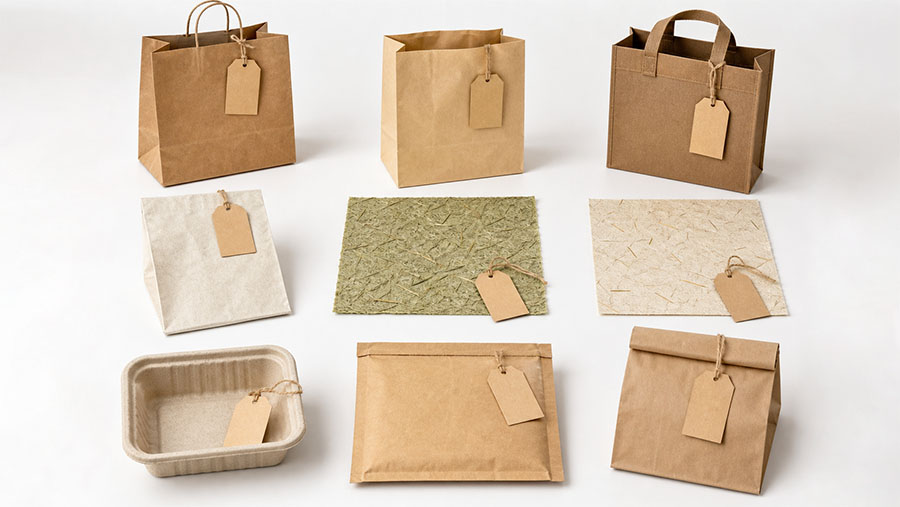
Why Look Beyond Traditional Paper Bags?
Brands look beyond traditional paper bags because “paper” alone is no longer enough to support a sustainability claim.
A standard paper bag may still create problems if it:
- Uses more material than the product needs
- Fails after one short carry
- Uses plastic lamination for appearance
- Has heavy ink coverage that complicates geri dönüşüm
- Does not meet food contact requirements
- Makes environmental claims without documentation
- Looks sustainable but does not match local recycling or composting systems
This is where many buyers underestimate the issue. Packaging sustainability is not decided by the material name. It is decided by the full specification: fiber source, weight, structure, coating, ink, strength, certification, and end-of-life route.
A simple kraft paper bag can be a good option. It can also be the wrong option if it tears, gets wet, or uses a coating the local recycling system cannot handle.
Are Recycled Paper Bags a Good Alternative?
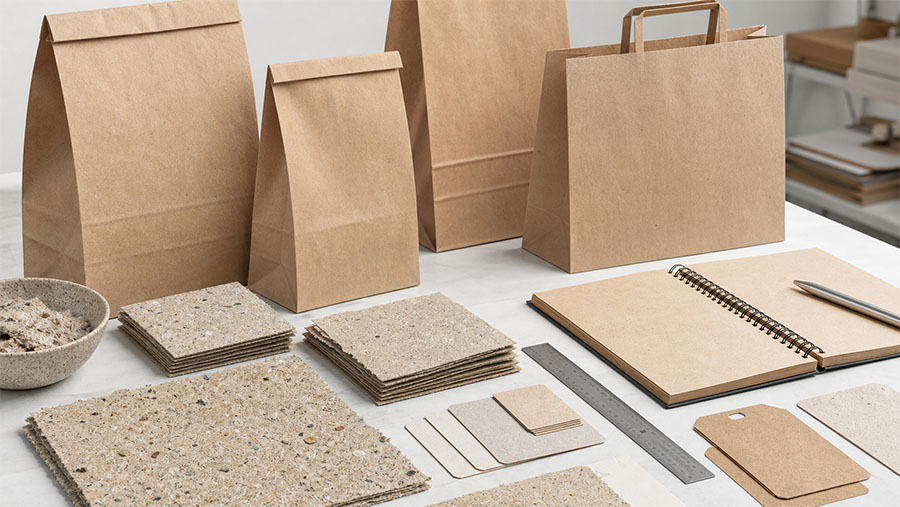
Evet. Recycled paper bags are often one of the most practical eco-friendly alternatives to traditional paper bags, especially for retail, grocery, promotional packaging, and general merchandise.
They reduce reliance on virgin fiber and can support a clear sustainability message when the recycled content is documented. They also work well for brands that want a natural look without moving into expensive specialty fibers.
But recycled paper is not one single material. The strength, color, surface texture, odor, and print result can change by grade and supplier.
A recycled paper bag should be checked for:
- Paper GSM and fiber quality
- Tensile and tear resistance
- Handle attachment strength
- Bottom strength
- Print clarity and color absorption
- Odor, especially for food or cosmetics
- Recycled content documentation
- Food contact suitability, if relevant
- Recyclability after printing or coating
The common mistake is treating recycled paper as a direct replacement without testing. In production, recycled fiber can behave differently during folding, gluing, and printing. If the bag is for heavy retail products or delivery use, the structure may need reinforcement.
What Makes FSC-Certified Paper Bags Different?
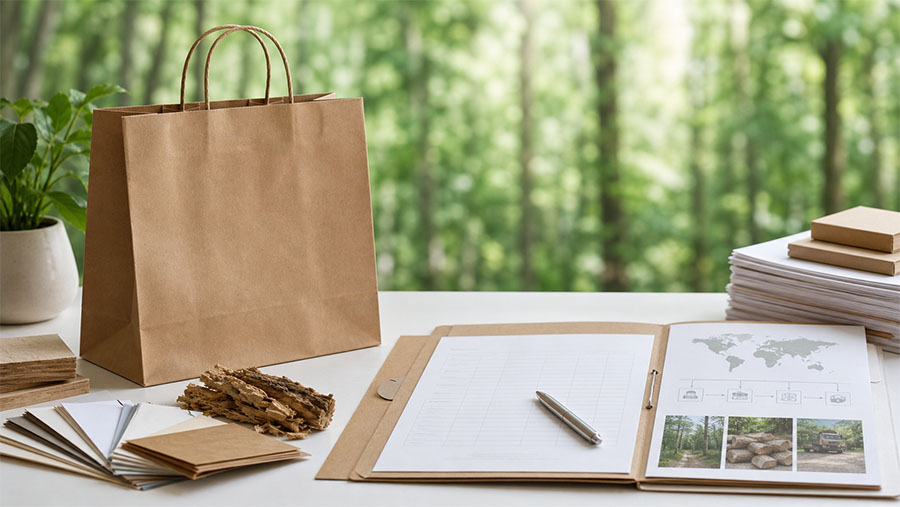
FSC-certified paper bags focus on responsible sourcing. The paper comes from sources managed under FSC rules, controlled sources, or reclaimed materials, depending on the certified claim.
For many brands, FSC-certified paper is a safer sustainability route than vague “eco paper” language because it connects the claim to a recognized chain-of-custody certification system.
FSC-certified paper bags can be used for:
- Retail shopping bags
- Food paper bags
- Gift bags
- Fırın poşetleri
- Coffee bags
- Luxury paper bags
- Paper courier bags
- Paket servis ambalajı
The main benefit is traceability. This matters for importers, distributors, and brand owners that need documents for internal sustainability reporting or retailer requirements.
The key warning is label control. A supplier cannot simply print an FSC logo because the paper is “forest-friendly.” The correct certificate scope, claim type, label approval, and document trail must be checked before production.
If certification is part of the buyer’s requirement, confirm it before artwork approval, not after mass production.
Are Reusable Paper Bags Better Than Single-Use Paper Bags?
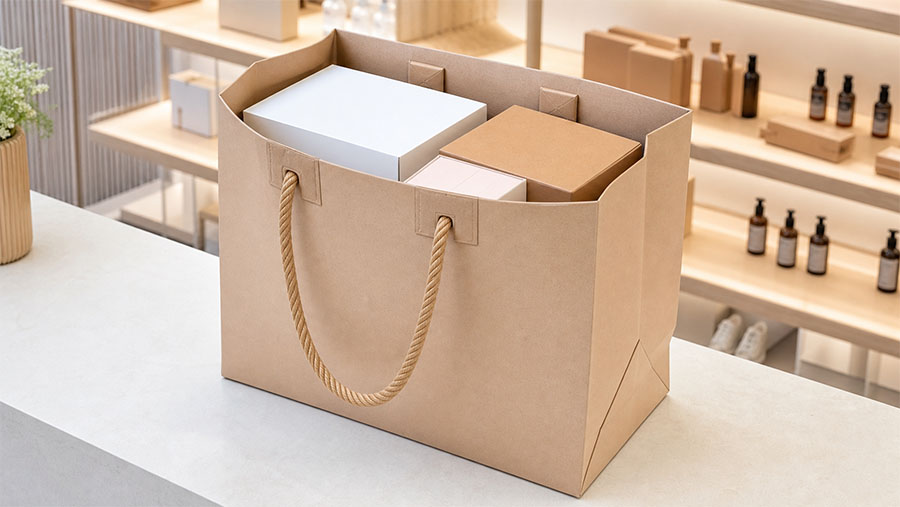
Reusable paper bags can be better when customers actually reuse them and the bag is designed to survive repeated handling.
That second part matters.
A reusable paper bag normally needs:
- Stronger paper or laminated paper alternatives
- Reinforced handle areas
- Better bottom support
- Reliable glue
- Proper side gusset design
- Stronger printing and surface protection
- A structure matched to the product weight
Reusable paper bags are especially useful for fashion retail, cosmetics, gift packaging, trade shows, premium food brands, and brand events. They can also keep the brand visible after the first purchase.
But a reusable paper bag is not sustainable just because it is thicker. If customers do not reuse it, the extra material may not deliver the intended benefit. If the handle fails on the second use, the brand loses both the sustainability story and the customer’s trust.
For reusable designs, test the bag with the real product weight and carrying route. Static load testing alone is not enough. Repeated lifting, swinging, and setting down often reveal weak points around handles and bottom seams.
Can Compostable Paper Bags Replace Traditional Paper Bags?
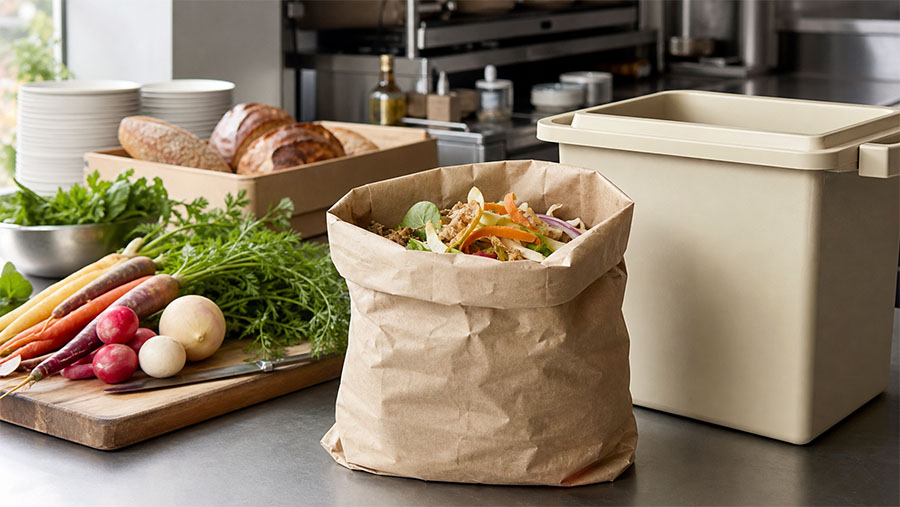
Compostable paper bags can replace traditional paper bags in selected applications, especially food scraps, produce, bakery items, foodservice, and event packaging.
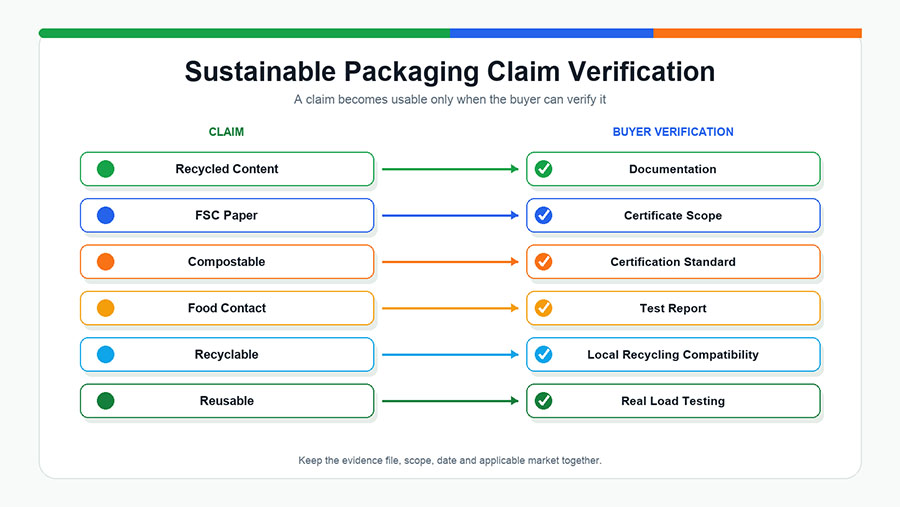
But compostable does not mean “disappears anywhere.” Compostability depends on material composition, coating, adhesive, ink, and access to the right composting system.
This is where brands often overclaim. A bag may be industrially compostable but not suitable for home composting. A paper bag may look natural but include a coating that changes its disposal route.
Before using compostable paper bags, buyers should understand the difference between compostable vs recyclable paper bags and confirm:
- Whether the bag is industrially compostable, home compostable, or only partially compostable
- Which compostable packaging standard or certification applies
- Whether the coating, adhesive, and ink are included in the certification
- Whether customers in the target market have access to composting infrastructure
- Whether the bag also needs grease or moisture resistance
Compostable packaging can be a good choice when the disposal route is realistic. Without that route, it may become a claim that sounds better than it performs.
What Are Grass Paper Bags?
Grass paper bags are made with grass fiber blended with other paper fibers. They are used by brands that want a natural texture, lower-impact fiber story, and a visible difference from standard kraft paper.
Grass paper can work for:
- Dry retail goods
- Organic products
- Hediye paketleme
- Promotional bags
- Boutique shopping bags
- Selected dry food packaging, if tested and approved
The visual advantage is strong. Grass paper often has a softer, more natural appearance. It can help a brand communicate sustainability without relying on heavy graphics.
The production risk is that alternative fibers do not always behave like standard kraft paper. Folding, gluing, printing, and load performance need to be tested before bulk orders.
Grass paper is a good option when the brand wants a distinctive natural look and the product does not demand heavy-duty strength or complex barrier performance.
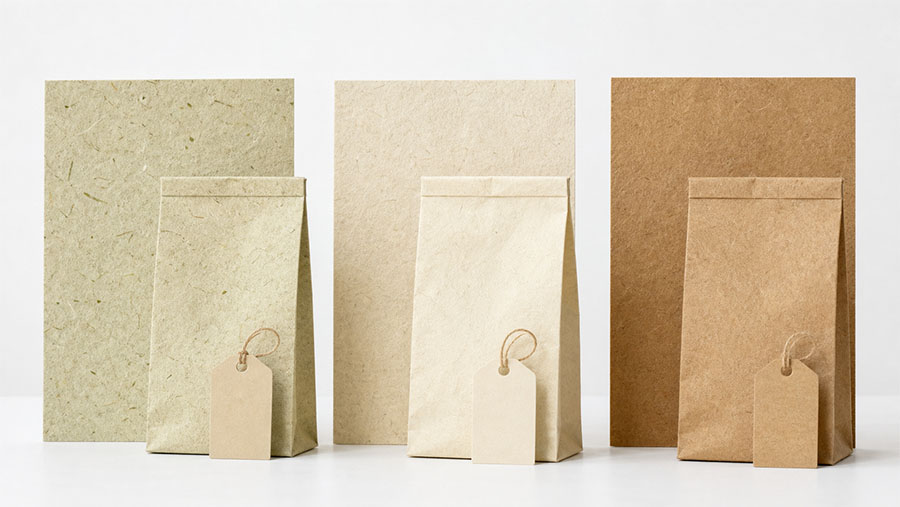
Are Bamboo Paper Bags a Practical Alternative?
Bamboo paper bags can be practical when the material supply, certification, printability, and strength are clear.
Bamboo grows quickly, and bamboo fiber is often positioned as a renewable alternative fiber. For premium eco brands, cosmetics, tea, gifts, and dry retail products, bamboo paper can support a natural packaging story.
But bamboo paper should not be selected only because it sounds sustainable.
Buyers should check:
- Fiber sourcing
- Processing method
- Paper strength
- Surface texture
- Printing performance
- Cost and availability
- Certification or documentation
- End-of-life route in the target market
A material can be renewable and still be the wrong packaging choice if the supply chain is unstable, the print result is poor, or the bag cannot meet the product weight.
Bamboo paper is best treated as a tested material option, not a marketing shortcut.
How Do Molded Fiber and Pulp Packaging Compare with Paper Bags?
Molded fiber and pulp packaging are not direct replacements for paper shopping bags. They solve a different problem.
Paper bags carry.
Molded fiber protects.
Molded fiber packaging is formed into trays, inserts, clamshells, cup holders, and protective structures. It can replace some foam, plastic trays, or rigid inserts in e-commerce, foodservice, electronics, cosmetics, and fragile goods.
It works well when the product needs:
- Shape protection
- Shock absorption
- Separation inside a box
- Plastic reduction
- Recyclable or fiber-based presentation
- Premium unboxing structure
For e-commerce brands, molded fiber may work together with a paper courier bag or retail paper bag. The courier bag handles the outer shipping route. The molded fiber insert protects the product inside. The retail bag improves the customer presentation.
Sustainable packaging is often a system, not a single item.
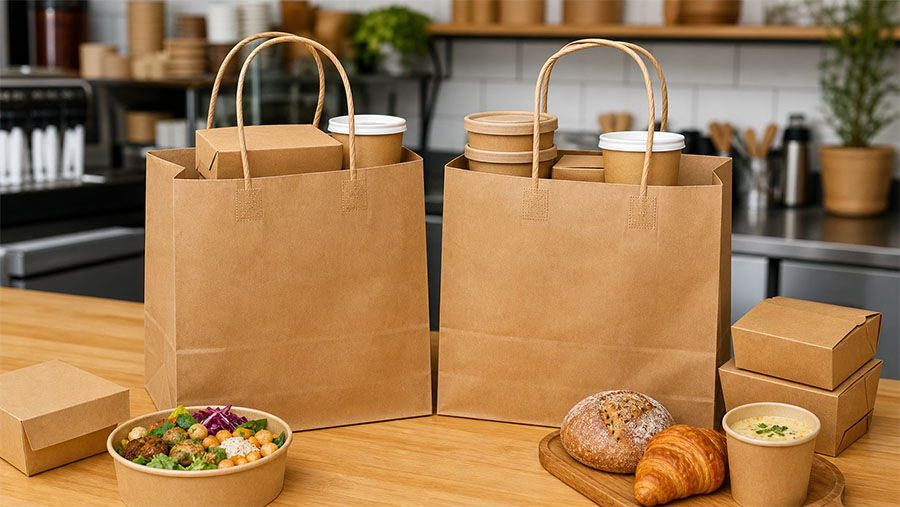
What Are Plastic-Free Takeaway Paper Bags?
Plastic-free takeaway paper bags are designed to reduce plastic components in restaurant, cafe, bakery, and food delivery packaging.
They may use kraft paper, flat paper handles, twisted paper handles, square-bottom structures, water-based inks, and paper-based coatings. The goal is to keep the bag practical for foodservice while reducing unnecessary plastic layers.
Plastic-free takeaway bags should be checked for:
- Food contact suitability
- Sap gücü
- Bottom stability
- Grease resistance
- Moisture exposure
- Heat and steam conditions
- Print safety
- Packing speed in restaurants
- Delivery handling
This category is easy to underestimate. Hot food creates steam. Sauces create moisture. Delivery creates movement. For oily or moist food, greaseproof paper bags may be more relevant than a standard kraft takeaway bag. A bag that looks fine on a table may fail on a scooter during a dinner rush.
For takeaway packaging, structure is as important as material. A square-bottom or flat-bottom design often improves stability for food containers, cups, and meal boxes.
Can Paper Courier Bags Replace Traditional Shopping Bags?
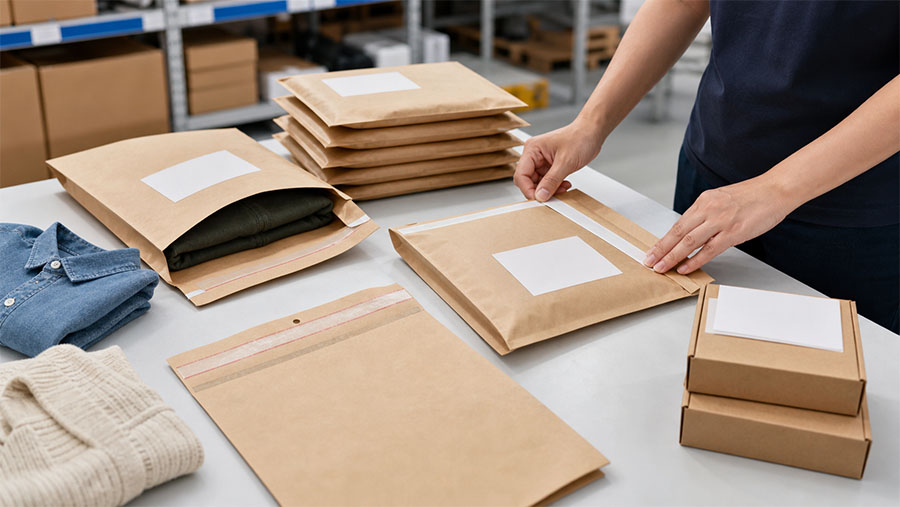
Paper courier bags can replace traditional shopping bags only when the use case is e-commerce shipping, not in-store hand-carry retail.
A shopping bag and a courier bag are built for different jobs.
| Bag type | Main use | Typical structure | Main durability concern |
|---|---|---|---|
| Shopping bag | Store pickup, retail carrying | Open top, handles, gusset, bottom support | Handle and bottom strength |
| Paper courier bag | E-commerce shipping | Self-seal closure, tear strip, flat mailer shape | Tear resistance, sealing, moisture exposure |
| Takeaway paper bag | Food delivery and pickup | Flat or square bottom, handles | Bottom stability, grease, steam, carrying load |
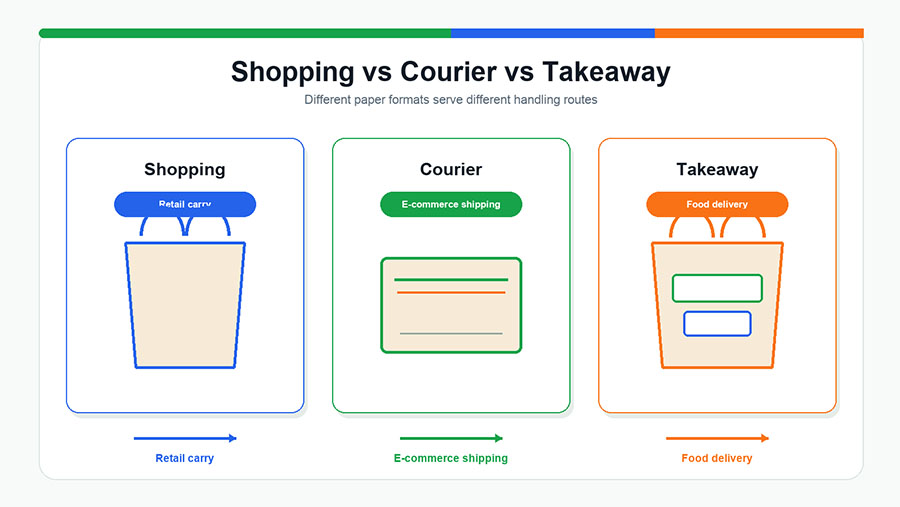
Paper courier bags are useful for apparel, accessories, documents, cosmetics boxes, books, stationery, subscription products, and soft goods. They can reduce plastic mailer use and improve the unboxing experience.
But they are not suitable for every product. Sharp, fragile, heavy, or moisture-sensitive goods may need inner protection, cartons, molded fiber inserts, or additional wrapping.
Are Minimalist Paper Bags More Eco-Friendly?
Minimalist paper bags can be more eco-friendly when the design reduces unnecessary material complexity.
A minimalist eco paper bag may use:
- Natural kraft paper
- One-color printing
- Low ink coverage
- No plastic lamination
- No metal eyelets
- No unnecessary ribbons
- Simple paper handles
- Clear recycling instructions
- Right-sized dimensions
The benefit is not just visual. Simpler materials can reduce cost, improve recyclability, and make production more stable.
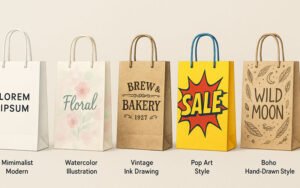
But minimalism does not excuse weak structure. A thin bag with poor print and weak handles does not look sustainable. It looks unfinished.
For premium minimalist bags, paper texture, print contrast, handle choice, and bottom structure must be selected carefully. When the design is simple, every production detail becomes more visible.
Start with the product-fit and application requirements, then compare the environmental options against that same specification. For sourcing and label documentation, use the eco-label scope and certificate checklist.
How Should Brands Choose the Right Eco-Friendly Alternative?
Brands should choose the eco-friendly paper bag alternative by product use first.
Before choosing the material, confirm:
- What product will the bag hold?
- Is it food or non-food?
- Is there direct food contact?
- How heavy is the product?
- Does it need grease resistance?
- Does it need moisture resistance?
- Will customers reuse it?
- Does it need premium printing?
- Does it need certification?
- Which market will it enter?
- What disposal route exists there?
- What is the order quantity?
- What is the budget?
- What is the delivery deadline?
Then match the packaging direction:
| Buyer need | Better direction |
|---|---|
| Reduce virgin fiber | Recycled paper bags |
| Responsible sourcing claim | FSC-certified paper bags |
| Premium retail reuse | Reusable paper bags |
| Food waste or produce use | Compostable paper bags, if certified and locally compostable |
| Natural material story | Grass paper or bamboo paper bags |
| E-commerce shipping | Paper courier bags |
| Yemek teslimatı | Plastic-free takeaway paper bags |
| Fragile product protection | Molded fiber inserts plus outer packaging |
| Better recyclability | Minimalist paper bags with low material complexity |
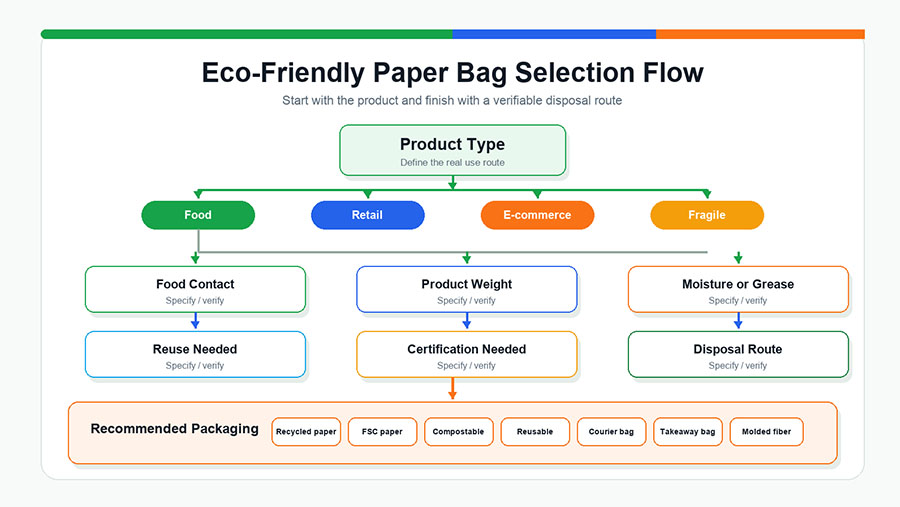
The wrong sequence is choosing a trend first and forcing the product to fit it. The better sequence is product → handling route → compliance → disposal route → material → design.
How Can GreenWing Support Eco-Friendly Paper Bag Alternatives?
GreenWing Packaging manufactures paper bags for B2B buyers, importers, distributors, wholesalers, and brand manufacturers.
Our paper packaging range includes:
- Handheld paper bags
- Square-bottom paper bags
- Flat-bottom paper bags
- Paper courier bags
- Food paper bags
- Paket servis ambalajı
- Recycled paper bag options
- FSC paper bag options
- Kraft paper bags
- White kraft paper bags
- Grease-resistant paper bags
- Plastic-free takeaway bags
- Reusable retail paper bags
- Custom printed paper bags
For eco-friendly alternatives, the useful work happens before mass production. We help buyers confirm paper type, GSM, handle structure, bottom design, printing method, coating needs, certification requirements, sample testing, packing method, and lead time.
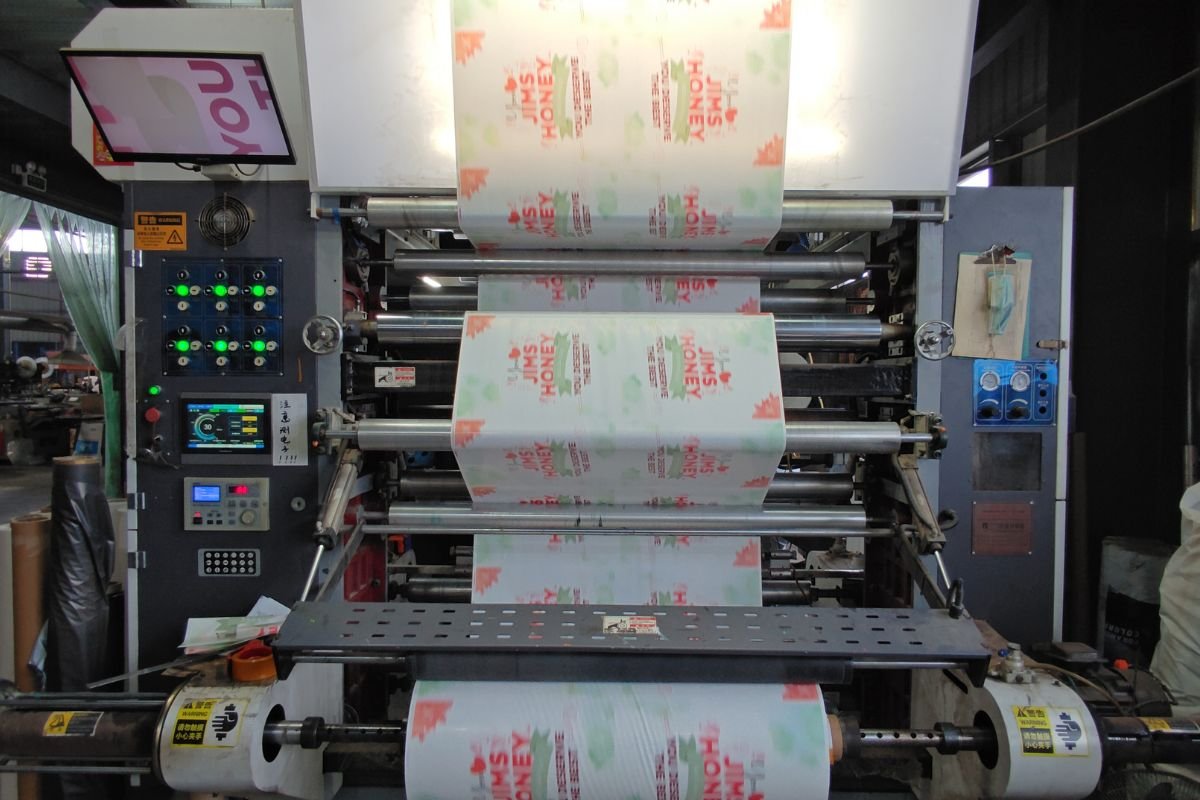
GreenWing was established in 2008. The company operates large-scale production facilities with automatic bag-making machines, square-bottom machines, coating machines, printing machines, paper cutting machines, and related equipment.
That capacity matters when the packaging idea must move from sample to wholesale production. A good eco-friendly paper bag has to be printable, stable, compliant, and repeatable at scale.
Daha Fazla İlgili Soru
What is the most eco-friendly alternative to traditional paper bags?
There is no single best option for every product. Recycled paper bags reduce virgin fiber demand. FSC-certified bags support responsible sourcing. Reusable paper bags help when customers actually reuse them. Compostable paper bags work when the composting route exists and the claim is certified.
Are recycled paper bags strong enough?
Yes, recycled paper bags can be strong enough for many retail and grocery uses. Strength depends on paper grade, fiber quality, GSM, bag structure, glue, handles, and bottom design. Buyers should test samples before bulk production.
Are bamboo paper bags better than kraft paper bags?
Not always. Bamboo paper can support a renewable fiber story, but kraft paper is widely available, strong, printable, and proven in many bag structures. The better choice depends on cost, supply stability, certification, strength, and brand positioning.
Can eco-friendly paper bags be used for food?
Yes, if the material, coating, ink, and adhesive are suitable for the intended food contact use. For direct food contact, buyers should request relevant food contact documentation and confirm whether the food is dry, oily, hot, moist, or chilled.
Do compostable paper bags always break down at home?
No. Some compostable bags require industrial composting conditions. Home composting depends on certification, coating, temperature, moisture, and time. Brands should not make home compostable claims unless the product is certified for that route.
Can eco-friendly paper bags be custom printed?
Yes. Eco-friendly paper bags can be custom printed with logos, brand colors, QR codes, recycling instructions, and product information. Water-based inks and lower ink coverage are often used when brands want a simpler sustainability profile.
What should buyers ask suppliers before ordering?
Ask about paper material, GSM, recycled content, FSC certification, food contact safety, printing method, coating, recyclability, strength testing, samples, lead time, packing method, and export experience. Documents matter as much as samples when sustainability claims are involved.
The Practical Boundary
Eco-friendly alternatives to traditional paper bags are not chosen by trend. They are chosen by function, proof, and production reality.
A good alternative should carry the product, support the brand claim, meet the target market’s requirements, and fit the disposal system customers actually use.
If the bag cannot prove its material claim, cannot survive handling, or cannot be produced consistently at wholesale volume, it is not a better alternative. It is just a better-looking risk.