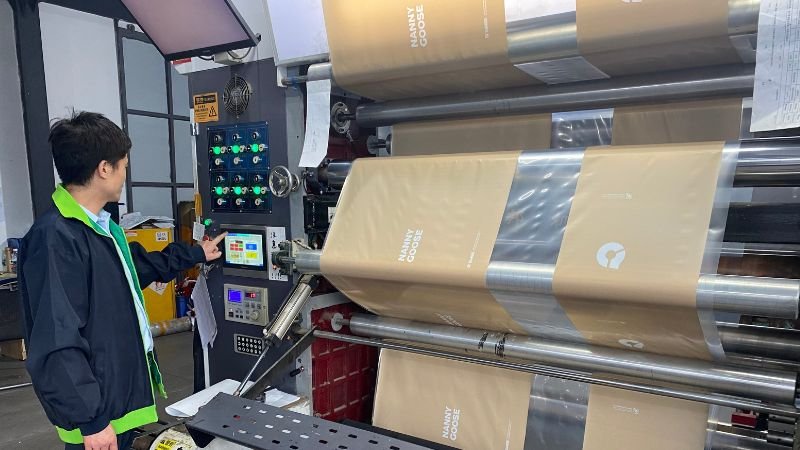

E-commerce teams often replace plastic packaging with paper and assume the sustainability work is finished. That shortcut ignores fibre sourcing, bag weight, coatings, parcel damage, transport volume, and what local recyclers can actually process.
For sustainability in e-commerce packaging, paper bags work best when they are right-sized, responsibly sourced, strong enough for the delivery route, and recyclable in the destination market. Paper alone is not proof of a lower-impact package.
What Makes a Paper E-commerce Bag Sustainable?
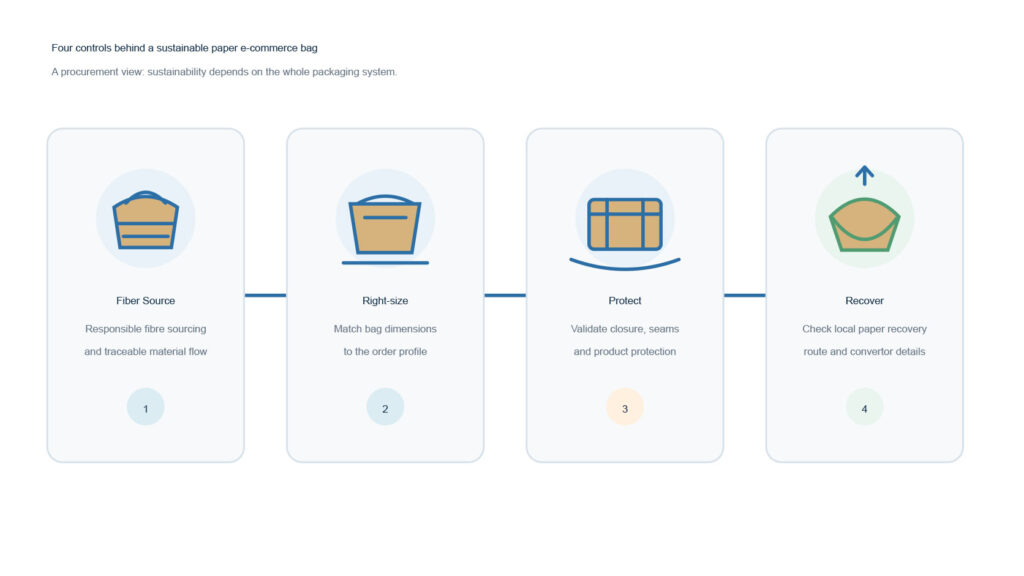
A sustainable paper bag protects the order with the least practical amount of material and leaves a credible recovery route after delivery. The material choice matters, but the packaging system matters more.
In a real e-commerce program, we evaluate five linked questions:
- Is the fibre recycled, responsibly sourced virgin fibre, or a controlled blend?
- Is the paper weight matched to the product and distribution route?
- Do coatings, windows, tapes, inks, and adhesives allow the bag to be recycled?
- Does the bag prevent damage through packing, sorting, transport, and final-mile delivery?
- Can customers identify the correct disposal route in the market where the bag is sold?
A weak bag that causes a return shipment is not a material-saving success. A heavy, laminated bag may look premium but can use more fibre and become harder to recycle. Sustainability comes from balancing protection, material efficiency, and end-of-life performance—not maximizing one attribute.
When Do Paper Bags Fit E-commerce Fulfilment?
Paper shipping bags are most suitable for soft, light, non-fragile products that do not need rigid compression protection. Apparel, textiles, accessories, books with secondary protection, and selected packaged consumer goods are common candidates.
| Order profile | Paper bag suitability | Main design check |
|---|---|---|
| Apparel and textiles | Ridicat | Tear resistance, closure integrity, rain exposure |
| Boxed cosmetics or small accessories | Conditional | Puncture risk, corner abrasion, internal movement |
| Books and flat printed products | Conditional | Edge protection and moisture resistance |
| Electronics, glass, or fragile products | Low as a primary shipper | Rigid protection and cushioning are usually required |
| Chilled, frozen, or leak-prone goods | Low unless engineered as a system | Barrier, sealing, food-contact, and recycling compatibility |
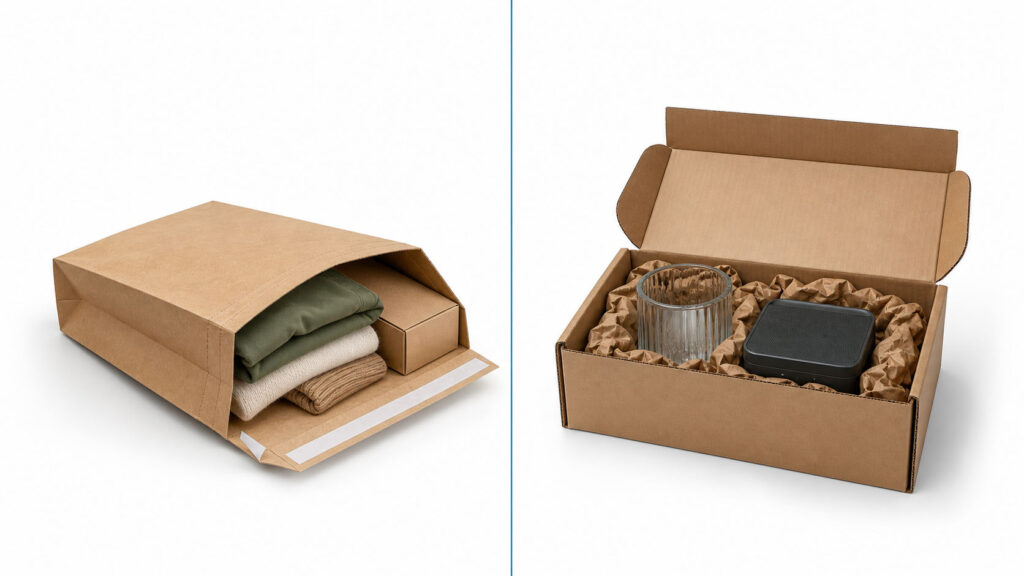
Paper bags can reduce unused parcel volume because the pack conforms more closely to the order than a fixed-size box. That advantage disappears when the bag needs excessive internal wrapping, a second mailer, or a rigid insert to survive distribution.
How Does Right-Sizing Improve Sustainability in E-commerce Packaging?
Right-sizing usually delivers a more dependable improvement than changing colour, adding an environmental logo, or increasing recycled content without checking performance. A smaller bag uses less paper, needs less adhesive, occupies less warehouse space, and can improve parcel density in transport.
The EU Packaging and Packaging Waste Regulation makes this operational issue more visible. It requires packaging weight and volume to be minimized and sets a maximum empty-space ratio for grouped, transport, and e-commerce packaging from 2030. The direction is clear even for brands outside the EU: oversized shipping packs are becoming harder to justify.
Right-sizing should be based on order data, not the dimensions of one product sample. Review:
- The top order combinations by shipment volume
- Filled dimensions rather than flat bag dimensions
- Closure space and peel-and-seal placement
- Product corners that can create puncture points
- Packing-line speed and operator tolerance
- Carrier dimensional-weight rules
- The number of bag sizes the warehouse can manage without selection errors
The lowest-material design is not always the smallest possible bag. If operators struggle to load it, seams are placed under constant stress, or the closure lands on a product edge, damage rates can rise after repeated handling.
Should You Specify Recycled Fibre or FSC-Certified Fibre?
Use recycled fibre and FSC-certified fibre as separate specification decisions. They answer different questions.
Recycled content reduces demand for virgin material, but the achievable percentage depends on strength, appearance, print expectations, and the recovered-paper supply available to the mill. Virgin kraft fibres can provide higher tensile and tear performance at a lower basis weight in demanding applications. A heavier recycled sheet is not automatically the lower-impact option.
FSC chain-of-custody certification verifies the controlled path of eligible forest-based materials through the supply chain. It supports responsible sourcing claims. It does not, by itself, prove that the finished bag is recyclable, compostable, carbon neutral, or made with a particular recycled-content percentage.
| Claim or specification | What it can support | What still needs verification |
|---|---|---|
| Post-consumer recycled content | Use of fibre recovered after consumer use | Declared percentage, calculation method, and supplier evidence |
| Pre-consumer recycled content | Use of manufacturing recovered material | Definition, percentage, and chain documentation |
| FSC 100%, FSC Recycled, or FSC Mix | FSC sourcing and chain-of-custody claim | Valid certificate scope, product group, and trademark approval |
| Reciclabil | Potential compatibility with a collection and recycling system | Whole-pack design, test method, local access, and disposal instructions |
| Compostabil | Performance under a defined composting standard and conditions | Finished-pack certification, facility access, and contamination risk |
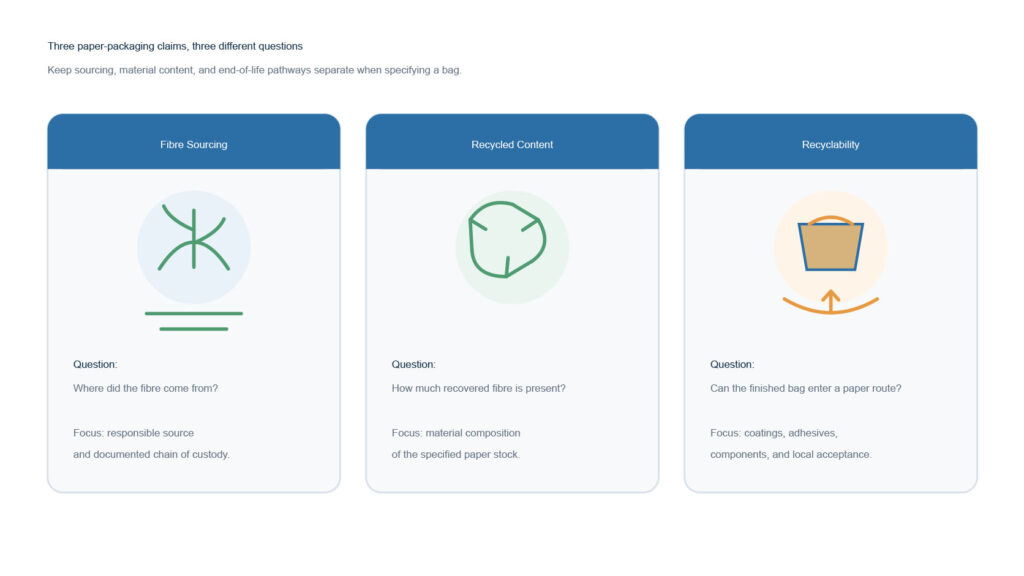
For procurement, ask the converter to state the exact paper grade, basis weight in GSM, recycled-content claim, and chain-of-custody claim on the quotation. “Kraft paper” is a material family, not a complete sustainability specification.
Can Coated or Printed Paper Bags Still Be Recycled?
Often yes, but recyclability depends on the complete construction. Paper mills need recoverable fibre and must be able to separate or tolerate non-fibre components during pulping and screening.
Water-based coatings are not automatically recyclable. Likewise, a thin plastic film is not automatically disqualifying in every system. The decisive questions are repulpability, fibre yield, screen rejects, sheet adhesion, and the capabilities of the target recycling infrastructure. CEPI and the 4evergreen alliance publish test methods and design guidance for fibre-based packaging, including treatment of coatings, adhesives, inks, and other components.
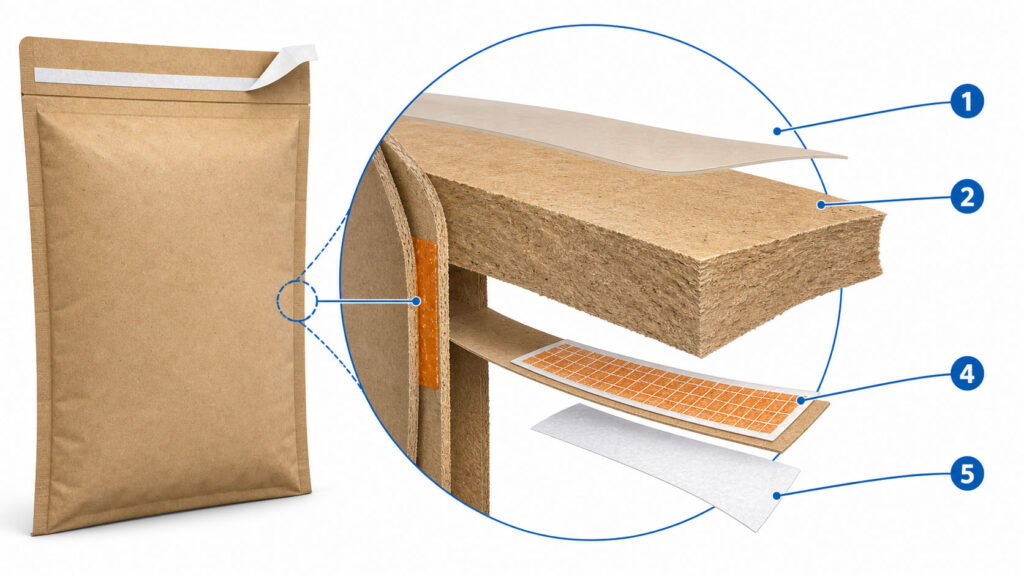
The common design risks are:
- Full-surface plastic lamination added mainly for appearance
- Large film windows or non-paper handles
- Silicone release liners left attached after opening
- Adhesives that fragment into problematic particles during repulping
- Heavy ink coverage combined with metallic, UV, or specialty effects
- Barrier layers selected without a defined moisture or grease requirement
Before mass production, specify whether the bag must pass a recognized repulpability or recyclability evaluation. A supplier statement such as “paper is recyclable” describes the base material, not necessarily the converted bag.
How Much Paper Weight Is Enough?
The correct GSM is the lowest basis weight that meets the distribution test and damage target for the actual order profile. There is no universal sustainable GSM.
A paper grade with stronger long fibres may outperform a higher-GSM sheet made from a different furnish. Bag geometry also changes performance: gusset depth, seam overlap, paper grain direction, closure design, and perforations can matter as much as nominal paper weight.
For a new program, the specification should connect GSM to measurable use conditions:
| Input | Why it changes the specification |
|---|---|
| Maximum packed weight | Sets tensile, seam, and closure demand |
| Product shape and corner radius | Changes puncture and abrasion risk |
| Bag width, gusset, and length | Changes stress distribution and material use |
| Humidity and rain exposure | Paper strength can decline when moisture increases |
| Courier handling cycle | Repeated drops, compression, and conveyor contact expose weak points |
| Print and finishing coverage | Can affect fibre recovery, drying, scuffing, and cost |
Do not approve the bag from an empty sample. Test it filled, closed, conditioned, dropped, compressed, and handled through a representative route. If the design is intended for humid markets, conditioning at the expected temperature and relative humidity should be part of the test plan.
Does Reuse Make a Paper Bag More Sustainable?
Reuse can improve material productivity, but only when the bag is designed and actually used for multiple cycles. A second tear strip, return closure, or reinforced opening can support e-commerce returns. Those features also add material and converting steps, so the expected return rate matters.
Life-cycle results are sensitive to the reference bag, energy mix, bag weight, and number of uses. A widely cited UK Environment Agency study found that a paper carrier bag needed at least three uses to achieve lower global-warming potential than a conventional lightweight HDPE carrier bag used once. That result should not be copied directly into every e-commerce claim; a shipping bag, retail carrier bag, and reusable return mailer have different weights and logistics.
For a credible reuse claim, define:
- The intended second or subsequent use
- Whether the closure survives opening
- Whether return instructions are clear
- The expected collection or return rate
- How damage, labels, and contamination are handled
“Reusable” should describe a functioning system, not just a bag that might survive another trip.
How Should Environmental Claims Be Written on the Bag?
Write claims narrowly enough that a procurement team can support them with evidence. Avoid broad statements such as “eco-friendly,” “green,” “plastic-free,” or “100% sustainable” unless the scope and proof are unambiguous.
Directive (EU) 2024/825 strengthens EU consumer protection against vague and misleading environmental claims. For brands selling into Europe, this changes packaging copy from a creative exercise into a substantiation task.
Use statements that identify the attribute and the boundary:
| Avoid | Use only when verified |
|---|---|
| Eco-friendly packaging | Bag contains X% post-consumer recycled paper by weight |
| 100% recyclable | Recycle with paper where local collection accepts paper shipping bags; remove the release liner |
| Sustainably sourced | FSC claim and label approved under the applicable chain-of-custody licence |
| Biodegradabil | Specific test standard, conditions, timeframe, and certified finished construction |
| Carbon neutral | Defined product boundary, calculation method, reporting period, and treatment of offsets |
Keep the evidence file with the approved artwork, material declaration, certificate scope, and test report. If the material or converter changes, review the claim again. Environmental copy should not remain frozen while the supply chain changes underneath it.
How Should You Validate a Paper Bag Before Launch?
Validation should move from material evidence to filled-pack performance and then to a controlled shipment trial. The objective is not to produce the strongest possible bag. It is to establish a repeatable specification with an acceptable damage rate and credible environmental claims.
1. Lock the material construction
Record the paper grade, GSM tolerance, fibre claim, coating, ink system, adhesive, closure tape, release liner, handle or reinforcement, and any non-paper component. Product descriptions such as “brown kraft mailer” are too loose for repeat orders.
2. Test the converted bag
Measure the characteristics that can change during production: dimensions, seam width, seal or adhesive performance, tensile strength, tear resistance, burst or puncture behaviour where relevant, and print rub resistance. Use a recognized transport-testing protocol when the packed product and route justify it.
3. Run filled-pack distribution trials
Pack the highest-risk product combinations, not only the easiest SKU. Include humid exposure, conveyor abrasion, compression, and opening evidence where these conditions occur. Record damage by failure mode so that the next revision addresses the actual weak point.
4. Verify the end-of-life claim
Review the whole construction against the recycling guidance for each target market. When coatings or mixed materials create uncertainty, use a recognized laboratory evaluation rather than relying on the paper supplier’s base-sheet claim.
A Practical Specification Checklist for Procurement
Before requesting quotations, provide:
- Product dimensions, packed weight, and order combinations
- Required internal bag dimensions and acceptable size tolerance
- Paper grade, target GSM, colour, and recycled-content requirement
- FSC claim requirement and destination-market label rules
- Moisture, grease, scuff, or puncture risks
- Closure type, return feature, tamper evidence, and release-liner design
- Printing method, number of colours, Pantone references, and ink coverage
- Coating or lamination requirement with its functional reason
- Filled-pack test protocol and acceptance criteria
- Destination markets and intended disposal message
- Annual volume, order quantity, packing-line method, and launch date
Without these inputs, suppliers usually compensate with extra paper, broader tolerances, or conservative construction. That can protect the quote, but it does not necessarily improve the package.
întrebări frecvente
Are kraft paper bags always recyclable?
No. Uncoated paper is generally compatible with paper recycling, but plastic films, release liners, windows, coatings, adhesives, and contamination can change the result. Evaluate the finished bag and local collection route.
Is recycled paper always better than virgin paper?
No. Recycled fibre can reduce virgin material demand, but strength, bag weight, damage rates, and supply-chain evidence still matter. Compare complete designs that provide the same protection.
Do paper e-commerce bags need FSC certification?
FSC certification is not a universal legal requirement. It is a sourcing and chain-of-custody choice that may be required by a brand policy, retailer standard, or customer contract.
The Boundary That Matters
A paper bag is a strong e-commerce option when it removes unnecessary volume without shifting risk into damaged goods, added liners, or unsupported claims. It is a poor option when a fragile product needs rigid protection or when moisture barriers turn a simple fibre pack into a difficult mixed-material structure.
The next specification decision needs order dimensions, packed weight, product edge and moisture risks, target markets, annual volume, print coverage, and the environmental claims you intend to place on the bag. Those inputs determine whether the lowest-impact solution is a lightweight paper mailer, a reinforced return bag, a corrugated format, or a different system entirely.