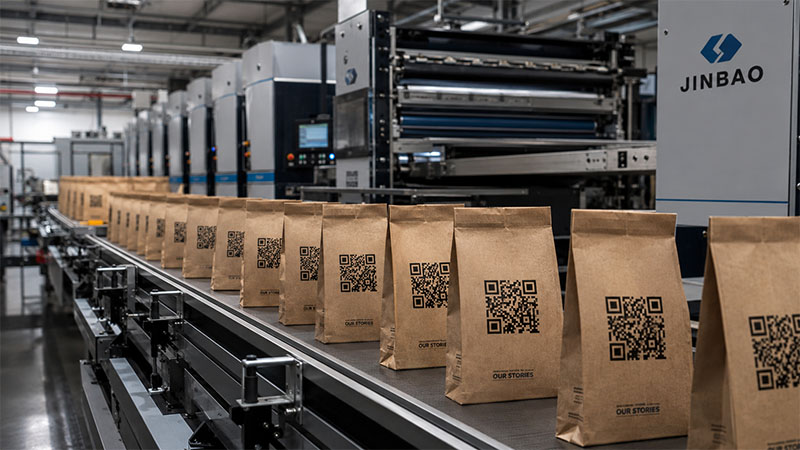
Most buyers spec interactive paper bags the way they spec catalog items. One QR code. One NFC tag. One AR trigger. The proof scans fine. The first 5,000 bags scan fine. Then the run length grows, the paper reel changes, the freight container heats up, and the campaign report shows a 6% scan-failure rate that nobody can explain.
That is not a design problem. That is a production-drift problem. Interactive elements behave differently in a 200,000-unit run than they do in a sample pack. The further a feature gets from the design file, the more sensitive it becomes to substrate batch, ink absorption, lamination, fold geometry, glue chemistry, and stacking pressure.
This article maps where QR codes, NFC tags, AR triggers, and physical interactive elements actually fail in mass production — not in the proof. The failure modes are usually not catastrophic. They are slow drift across batches, and they show up after the bag has already shipped.
Executive Summary
- QR readability on paper bags is rarely a print problem. It is a contrast-histogram drift caused by reel-to-reel variation in substrate brightness and ink absorption.
- NFC failures on paper bags rarely originate in the tag. They originate in glue migration, gusset folds across the antenna, and stacking pressure during ocean freight.
- AR triggers degrade silently: the artwork still looks correct to the human eye, but post-lamination the contrast values fall below the SDK detection threshold under warm retail lighting.
Why Buyers Underspec Interactive Paper Bags
Most procurement teams treat an interactive paper bag as a printed bag plus a feature. The artwork file has a QR placement. The BOM has an NFC SKU. The AR vendor provides a trigger PDF. The sample passes.
Then run length scales. And several things happen that no one specced:
- The paper supplier switches to a different bleach batch, shifting ISO 2470-1 brightness by 2–4 points.
- The flexo press operator increases ink density to compensate for a slightly absorbent reel.
- The bag-making machine folds the gusset directly across the NFC antenna loop.
- The bags are stacked 24 high in cartons, then 18 cartons per pallet, then sea-freighted for 28 days.
None of these are mistakes. They are the normal variance of mass production. But each one shifts the operating margin of an interactive feature. The QR code that scanned at 99.2% in the proof now scans at 93.8% in retail. That 5.4% looks small until you multiply it by a 200,000-bag campaign.
Teams underestimate this because the proof model assumes one variable at a time. Production stacks five.
QR Codes: Where Readability Actually Drifts
Substrate Variability Across Reels
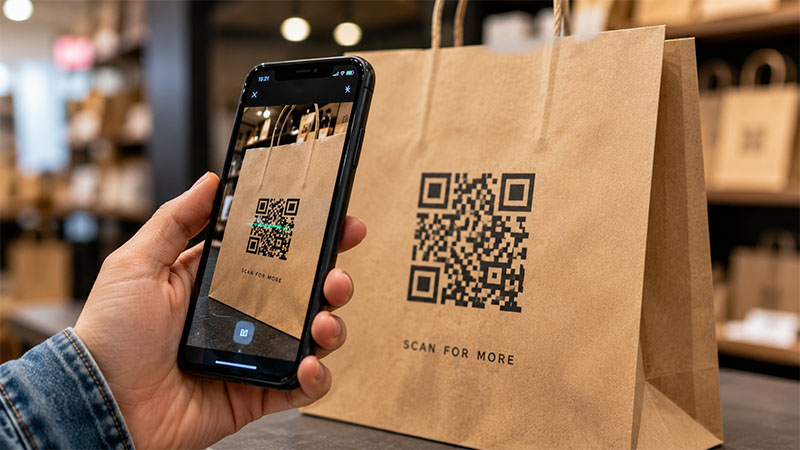
Kraft paper and white-top kraft are not consistent across batches. ISO 2470-1 brightness can vary ±3 points between reels from the same mill, and more across mills. A QR code generated to ISO/IEC 18004 with Level Q error correction tolerates 25% module damage on paper, but only if the contrast ratio between dark and light modules stays above roughly 55%.
When brightness drops on the light modules, that ratio compresses. The scanner still reads it. Most of the time. Until the light is yellow and the phone camera is two generations old.
Ink Absorption and the Contrast Histogram
Water-based flexo inks behave differently on uncoated kraft (high absorption) than on matte-laminated white-top (low absorption). The same Pantone Process Black artwork prints with measurably different L* values across these substrates. A 10–12 point L* shift in the dark modules is enough to push edge cases below the reliability threshold of older Android camera stacks.
This is rarely caught in pre-press, because pre-press evaluates one paper sample.
Fold and Crease Zone Problems
QR codes placed within 8–10 mm of a side gusset or bottom crease will eventually be partially folded in production. The bag-making machine does not respect artwork zones. It respects bag geometry. If the operator shifts the cut-off by 3 mm to correct a registration drift, the QR walks into the crease.
The detection point for this is the first 500 bags off the line, not the proof.
What Production-Side QC Should Actually Look For
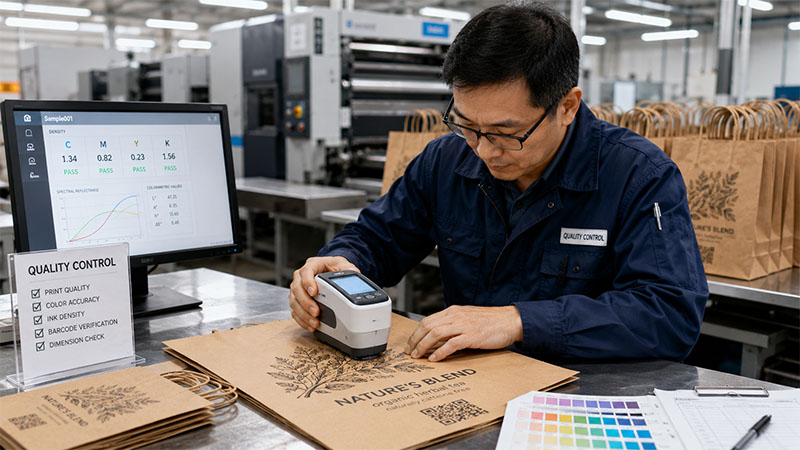
| Check | Tool | Pass threshold |
|---|---|---|
| Module contrast (dark vs light L*) | Spectrophotometer | ≥55% contrast ratio |
| Scan reliability | 10-phone panel, mixed iOS/Android, mixed lighting | ≥98% first-scan success |
| Distance from any fold | Caliper | ≥10 mm |
| Reel-to-reel brightness delta | Per-reel sampling | ≤3 ΔL* |
NFC Tags: Failure Modes Buyers Rarely Test

Tag Placement vs. Bag Geometry
A typical NTAG213 inlay operates at 13.56 MHz with a read range of about 20–40 mm on paper. That range collapses under three normal conditions: an antenna folded across a crease, an antenna placed within 15 mm of a metallized handle eyelet, and an antenna sandwiched between two layers of foil-stamped artwork.
Each of these is a normal feature of premium retail bags. None of them is in the NFC datasheet.
Glue, Lamination, and Detuning
The adhesive holding the inlay to the inside face of the bag is not chemically neutral. Solvent-based PUR adhesives can migrate into the antenna substrate over weeks, shifting capacitance enough to detune the resonance away from 13.56 MHz. Read range drops 20–40% over 90 days, even on bags that worked perfectly at packing.
Lamination has a related effect. A 15-micron BOPP film changes the dielectric environment around the antenna. Vendors will say it is compensated for. It is, for a fresh tag. Less so after a humidity cycle.
Stacking Pressure During Ocean Freight
A 40-foot container of paper bags experiences sustained compressive load and humidity cycling for 25–35 days. Inlays at the bottom of a pallet absorb both. Field reports from retail rollouts repeatedly show a 3–6% increase in dead-tag rate between factory QC and store-floor scanning, with no correlation to handling damage.
The damage is not mechanical. It is electromagnetic drift.
Why Standard Batch QC Misses This
Standard incoming NFC QC tests function at room temperature, on a flat antenna, immediately after lamination. None of those conditions match the bag’s eventual environment. A more honest test panel:
| Test | Condition | Sample size |
|---|---|---|
| Read after fold | Tag folded across antenna at 90°, then flattened | 30 units |
| Read after climate cycle | 70°C / 90% RH for 72 hours | 30 units |
| Read after stack pressure | 5 kg/cm² static load, 30 days | 30 units |
| Read range delta | Compared to t=0 baseline | All samples |
If the dead-tag rate at t+30 days exceeds 2%, the tag placement, glue chemistry, or lamination spec needs revision before mass production. Not after.
AR Triggers: The Silent Degradation Problem

AR image targets are not evaluated by human vision. They are evaluated by the AR SDK’s feature-point detector. Vuforia, 8th Wall, and similar engines look for high-contrast corners, asymmetric patterns, and stable feature density. A trigger that looks vibrant to the eye can score poorly, and vice versa.
Why “It Worked in the Studio” Is Misleading
Studio testing happens at roughly 800–1200 lux of neutral white light, on a flat printed sample, at 30 cm distance. Retail environments run at 300–500 lux, often warm color temperature (2700–3000 K), on a paper bag that is creased, partially shadowed, and held at variable distance.
Each variable subtracts from the SDK’s confidence score. The bag still triggers. Until two variables stack.
Lamination’s Effect on Feature Points
Matte lamination scatters light. It raises the apparent uniformity of the artwork and flattens the contrast gradient that the SDK uses for feature extraction. A trigger that scores 4/5 on the Vuforia rating tool unlaminated can drop to 2/5 after matte film. Gloss lamination has the opposite failure mode — specular reflection wipes out feature points under direct retail spotlights.
The Honest Detection Point
The QC step that actually predicts field behavior is to score the printed-and-finished bag through the SDK’s rating tool, under retail-equivalent lighting, before approving the run. Not the artwork file. Not the unlaminated proof.
Physical Interactive Elements: Where Paper Pushes Back
Scratch Panels and Coating Compatibility
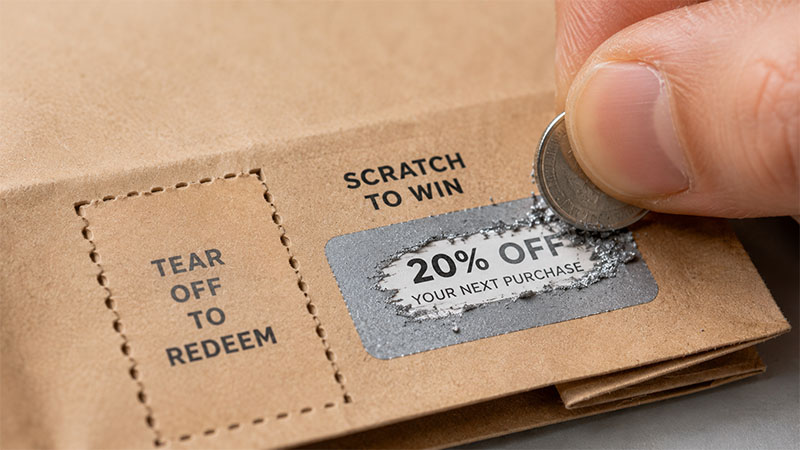
Scratch-off ink is silver latex bonded to a release layer (typically a UV varnish) on top of the printed message. The release layer must be tuned to the substrate. On uncoated kraft, release ink absorbs unevenly — the scratch panel either peels prematurely or refuses to scratch cleanly. On heavy matte lamination, the release layer can lift the lamination during scratching.
The tuning window is narrower than vendors advertise. Test on the actual paper, not a generic coated stock.
Perforation Depth vs. Load Bearing
A tear-off coupon at the top of a handled paper bag changes the bag’s load path. The handle reinforcement strip transfers load along the top edge. A perforation that crosses or weakens that path increases the failure rate of the bag under load — often invisibly, until a customer carries 4 kg of product and the handle tears at the perforation line.
The boundary: perforation should not cross the reinforcement strip, and tear strength along the perforation line should be verified at ≥1.2× the bag’s rated load.
What Changes After a 30-Day Humidity Cycle
Paper is hygroscopic. Perforation lines, scratch panels, and tear-off elements all behave differently after the bag has absorbed and released moisture during transit. Brittle perforations get more brittle. Scratch coatings can develop micro-cracks. A 30-day climate chamber cycle alternating 25°C/50% RH and 35°C/80% RH is the minimum sanity check before signing off a campaign run.
The Compliance Layer Most Buyers Skip
Food Contact Zones
If any part of the bag contacts food — even indirectly through wrapped product — the printed and coated layers fall under FDA 21 CFR 176.170 (paper and paperboard in contact with aqueous and fatty foods) in the US, or EU Regulation 1935/2004 with the EuPIA exclusion list for printing inks. Interactive elements complicate this because scratch ink, NFC adhesives, and AR-trigger varnishes are often not on the food-contact-approved substance list.
A buyer who specs “food-safe paper bag with scratch coupon” without clarifying which face of the bag the coupon sits on has created a compliance gap. The lab finds it later.
Ink and Coating Standards
Swiss Ordinance 817.023.21 Annex 10 and the EuPIA Suitability List define which substances can appear on food-adjacent printed packaging. Metallic inks, mineral-oil-based inks (MOSH/MOAH), and some UV-cured varnishes used as scratch-release layers are restricted. This is not a paper-bag-vendor decision. It is a documented chain-of-supply requirement, and the documentation needs to follow the bag.
NFC and Packaging Directives
In the EU, packaging containing electronic components — even passive RFID/NFC — interacts with the WEEE directive and the Packaging and Packaging Waste Regulation (PPWR). Passive NFC inlays are generally exempt from WEEE, but the bag now has to be separable for recycling or carry a recycling instruction. Exporters should confirm this with a compliance specialist, not with the bag vendor.
Decision Boundaries: Where Drift Becomes Someone’s Problem
| Caracteristica | Primary drift mode | First detectable at | Production-side control point | Buyer-side compliance exposure |
|---|---|---|---|---|
| QR code | Contrast-histogram shift across reels | First 500 bags / reel change | Per-reel L* sampling + 10-phone panel | Scăzut |
| NFC tag | Detuning from glue, fold, freight | t+30 to t+90 days | Climate + stack-pressure QC | Medium (WEEE / PPWR) |
| AR trigger | Feature-point loss after lamination | At lamination QC | SDK rating on finished bag, in retail light | Scăzut |
| Scratch panel | Release-layer / substrate mismatch | First 1,000 bags | Substrate-specific release tuning | Medium (food contact) |
| Tear-off / perforation | Load-path weakening + humidity brittleness | After 30-day transit | Tear strength + climate cycle | Scăzut |
What the Proof Cannot Show
Interactive paper bags are not “paper bag plus a feature.” They are a printed-electronic-mechanical assembly with a 30–90 day drift window that no single QC pass catches. The buyer who specs them like catalog items will see the failure rate in the campaign report, not in the proof.
Before locking the next interactive-bag spec, the information that actually determines feasibility:
- The exact paper grade, supplier, and acceptable reel-to-reel L* tolerance
- Whether the bag contacts food, and on which face
- The expected freight route, container dwell time, and humidity exposure
- The retail lighting environment (lux, color temperature) where AR or QR will be scanned
- The destination market’s compliance regime (FDA, EuPIA, Swiss Ordinance, PPWR, WEEE)
- The run length, because drift is a run-length problem
Without those inputs, the proof will pass and the run will drift. That is the part the proof cannot show.