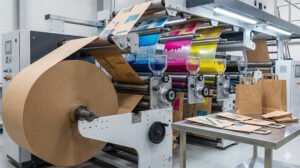

Paper packaging recycling regulations are no longer only a waste-management issue. They now affect packaging design, producer registration, reporting, fees, labels, and environmental claims. The difficult part is that a paper bag may be technically repulpable but still fail a local collection rule or a legal recyclability test.
Paper packaging must be designed for the recycling system where it will be sold. Buyers should confirm the responsible producer, material composition, local acceptance, labeling rules, and reporting duties before approving the final specification.
This guide reflects the regulatory position available in August 2026. It is practical packaging guidance, not legal advice.
What Do Paper Packaging Recycling Regulations Actually Control?
Paper packaging rules control more than whether a used bag goes into a paper bin. Depending on the market, they can govern the company responsible for the packaging, the data that must be reported, the fees paid, the design criteria used to assess recyclability, and the claims printed on the pack.
The practical compliance chain has five parts:
- Producer responsibility: Which company is legally responsible—the brand owner, importer, marketplace, packer/filler, or supplier of empty packaging?
- Material reporting: How much paper, fiber, plastic, aluminum, adhesive, or other material is placed on the market?
- Design for recycling: Can the finished packaging be collected, sorted, and processed at scale?
- Consumer labeling: Which recycling symbol, sorting instruction, or environmental claim is allowed?
- Evidence: What specification, test result, supplier declaration, or packaging data record supports the decision?
A material declaration from a paper bag factory helps with items 2, 3, and 5. It does not automatically complete the brand owner’s registration or reporting obligations.
How Do Paper Packaging Recycling Regulations Differ Across Markets?
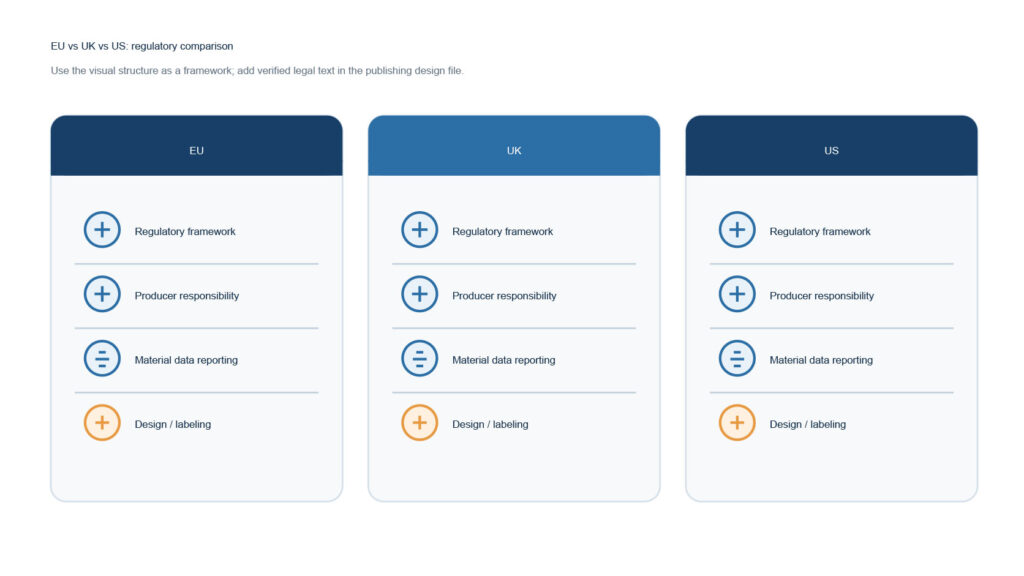
The EU, UK, and US are moving in the same direction: the company placing packaging on the market carries more financial and reporting responsibility. The implementation model is different in each region.
| Market | Current framework | What changes for a paper packaging buyer |
|---|---|---|
| European Union | Regulation (EU) 2025/40, the Packaging and Packaging Waste Regulation (PPWR), generally applies from 12 August 2026. | Design, minimization, recyclability, labeling, substances of concern, and producer registration must be reviewed as one compliance file. |
| United Kingdom | Packaging EPR requires obligated organisations to collect and report packaging data and, depending on size and activity, pay fees and meet recycling obligations. | Accurate packaging weight, material classification, household/non-household status, and recyclability assessment affect reporting and cost. |
| United States | There is no single national packaging EPR system. State programs and labeling laws apply on different schedules. | A specification that works in one state may require different registration, reporting, fee, or claim treatment in another. |
What Does the EU PPWR Mean for Paper Packaging?
Itu EU PPWR covers packaging regardless of material or origin. It entered into force on 11 February 2025 and generally applies from 12 August 2026. Its stated direction is to make packaging on the EU market recyclable in an economically viable way by 2030.
For paper packaging, the base sheet is rarely the only issue. The finished construction matters. A kraft paper bag with paper handles and limited ink is different from a shopping bag with plastic film lamination, polyester ribbon handles, metal eyelets, hot-melt adhesive, and foil decoration.
Which paper bag features need review under PPWR?
The main review points are:
- fiber composition and basis weight in GSM;
- wet-strength agents, barrier coatings, and grease-resistant treatments;
- plastic film lamination and the percentage of non-fiber material;
- handles, eyelets, windows, labels, tapes, and closures;
- ink and adhesive systems;
- packaging weight and avoidable empty space;
- food-contact use and substances of concern;
- the evidence supporting a recyclable, recycled-content, or compostable claim.
The PPWR also restricts PFAS in food-contact packaging above specified thresholds. For grease-resistant food paper, “fluorine-free” should therefore be supported by the coating formulation and, where required, testing—not inferred from the appearance of the paper.
The European Commission will continue to define detailed design-for-recycling criteria and assessment methods through secondary legislation. Do not freeze a 2030 claim today based only on the fact that the bag is made mainly from paper.
How Does UK Packaging EPR Affect Paper Bags and Cartons?
UK packaging EPR links packaging data and recyclability more directly to producer obligations and fees. According to current government guidance, an organisation generally needs to collect and report data when it has annual turnover of at least £1 million, was responsible for more than 25 tonnes of packaging in the previous calendar year, and carries out a covered packaging activity.
The responsible activity may include supplying own-brand packaged goods, placing goods into packaging, importing packaged products, operating an online marketplace, hiring reusable packaging, or supplying empty packaging. The legal producer is therefore not always the paper bag manufacturer.
Large organisations—currently defined by both annual turnover of at least £2 million and responsibility for more than 50 tonnes of packaging—have broader obligations. These can include six-monthly data reporting, waste disposal fees, scheme costs, registration charges, and PRN or PERN obligations.
For a paper packaging specification, record at least:
- unit weight of the complete bag or carton;
- weight by material, not only total pack weight;
- primary, secondary, shipment, or tertiary packaging class;
- household or non-household classification;
- coating, window, handle, label, and closure materials;
- number of units supplied into the UK;
- evidence used for the recyclability assessment.
The UK government states that fees will be lower for packaging that is easier to recycle. This makes a decorative material decision a recurring cost decision, not only a one-time printing choice.
Why Is US Paper Packaging Compliance State-Specific?
The United States does not currently have one harmonized packaging EPR framework. Brands must map where products are sold and then check producer definitions, exemptions, covered material categories, reporting dates, and labeling rules state by state.
Oregon’s Recycling Modernization Act covers packaging, paper, and food-service ware. From 2025 onward, covered producers generally must register with an approved producer responsibility organization, report supplied quantities, and pay fees; qualifying small producers are exempt.
Colorado’s Producer Responsibility Program covers packaging and paper products. Since 1 July 2025, a covered producer generally cannot sell or distribute products using covered materials in the state without participating in the program. Producer dues began in 2026.
California’s SB 54 covers single-use packaging, and CalRecycle’s covered-material categories include paper and fiber. California also regulates recyclability claims separately. A recycling symbol or “recyclable” statement should therefore be checked against current state requirements before artwork approval.
When Does a Paper Package Stop Behaving Like Paper in Recycling?

A package does not become non-recyclable because it contains one drop of ink or adhesive. The real question is whether the complete construction can be collected, sorted, repulped, and converted into usable fiber at acceptable yield and quality.
In production, the risk usually enters through functional or decorative additions. Each addition may look minor on an artwork file. Repeated across millions of units, it changes the amount of non-fiber material entering the recycling stream.
| Fitur | Recycling concern | Lower-risk direction |
|---|---|---|
| PE or BOPP film lamination | Creates a paper-plastic composite and may reduce fiber recovery. | Use unlaminated paper or a verified repulpable coating when barrier and appearance requirements allow. |
| Plastic or textile handles | Adds a separable or non-separable non-paper component. | Use twisted or flat paper handles, then verify adhesive and strength performance. |
| Metal eyelets | Adds another material and can complicate consumer separation. | Use reinforced paper handle patches if the load requirement can be met. |
| Heavy foil, glitter, or transfer decoration | Increases non-fiber residue and complicates environmental claims. | Limit coverage or replace with ink-based effects where brand requirements permit. |
| Grease or moisture barrier | Some coatings reduce repulpability or introduce restricted chemistry. | Specify the required KIT, Cobb, or WVTR performance, then select the lowest-complexity verified barrier. |
| Large labels and tapes | Adhesive and face-stock can create screening residue or stickies. | Minimize size and confirm compatibility with the intended paper recycling process. |
“Paper” is a material description. “Recyclable” is a system-level conclusion.
Can You Print “Recyclable” on Paper Packaging?
Yes, but the claim needs a defined scope and supporting evidence. A paper content percentage alone does not prove that the finished package is recyclable in every market.
Before printing the claim, answer four questions:
- Is the complete package technically recyclable, including coating, handles, adhesive, and decoration?
- Is it accepted by the collection and sorting system available to the target population?
- Is recycling available at the scale required by the applicable law or guidance?
- Does the artwork use the correct local label, language, and disposal instruction?
Avoid broad statements such as “100% recyclable everywhere,” “zero impact,” or “eco-friendly.” If the evidence only supports the paper body, say so and provide a separation instruction for the non-paper component. If local acceptance varies, direct the user to check local rules.
FSC chain-of-custody certification can support a responsible fiber-sourcing claim. It does not prove recyclability, recycled content, compostability, or compliance with EPR reporting.
Do Recycled Fibers Automatically Improve Compliance?
No. Recycled fiber content and recyclability are separate questions.
Recycled kraft can reduce demand for virgin fiber and may support a specific recycled-content claim when the percentage is documented. It can also have lower or more variable strength than an equivalent virgin kraft grade. To compensate, a buyer may increase GSM, add reinforcement, or introduce a barrier—changes that can alter pack weight, cost, and recyclability.
For a carrier bag, confirm recycled content together with tensile strength, tear resistance, handle-patch design, adhesive performance, and intended load. A 120 GSM recycled kraft sheet is not automatically equivalent to a 120 GSM virgin kraft sheet.
A useful supplier declaration should identify:
- paper grade and GSM;
- post-consumer and pre-consumer recycled content percentages;
- certification scope and certificate holder;
- coating and lamination chemistry;
- ink, adhesive, handle, and reinforcement materials;
- unit weight and material breakdown;
- applicable recyclability or repulpability test method.
What Should Buyers Lock Before Requesting Samples or Quotes?
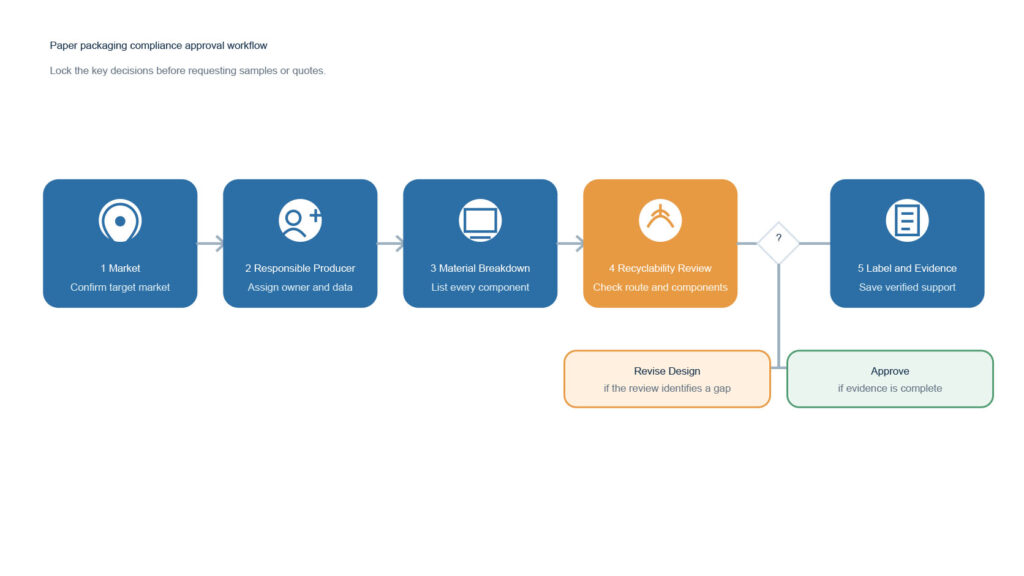
Regulatory risk is cheapest to control before the dieline and coating system are approved. Once artwork, barrier performance, and finishing are locked, changing the recycling profile often means repeating sampling, testing, color approval, and cost calculation.
Use this brief for the supplier:
- destination countries and US states;
- product type and whether it contacts food;
- bag or carton dimensions;
- target GSM and required load;
- virgin or recycled fiber requirement;
- coating, lamination, grease, and moisture requirements;
- handle, window, closure, label, and tape materials;
- print colors and decoration coverage;
- expected annual volume by market;
- environmental claims planned for the artwork;
- test reports, declarations, and material data required by the compliance team.
The boundary is simple: a factory can document and engineer the packaging construction, but the company placing the packaging on the market must confirm its legal producer status, registrations, reporting, fees, and final consumer claims. That split should be written into the approval process before mass production.