Your bag is not just a bag. It is a moving advertisement, a customer experience, and sometimes the only part of your brand that leaves the store with the buyer. But when brands compare paper vs plastic bags customization, many only ask, “Which one is cheaper?” Wrong first question.
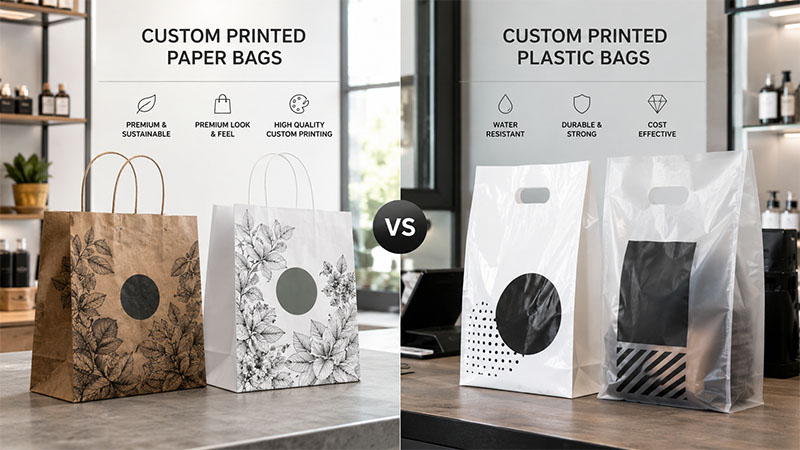
Paper bags usually offer stronger branding flexibility for premium retail, food packaging, gift packaging, and detailed print presentation. Plastic bags can still be useful for simple graphics, high-volume promotions, lightweight retail use, and moisture-resistant applications. The better choice depends on your artwork, printing expectations, handle structure, surface finishing, order quantity, and customer experience goals. If your brand needs rich textures, premium finishes, structured shapes, and strong shelf appeal, paper bags often give more creative room.
I have made paper bags since 2008, so yes, I am biased. But I am not blind. Plastic bags have their place. Paper bags have their place. The trick is knowing which material lets your brand look like a brand, not like a last-minute supermarket decision.
What Does Paper vs Plastic Bags Customization Really Mean?
When I talk about paper vs plastic bags customization, I am not only talking about printing a logo.
That is the basic level.
Customization includes size, shape, material thickness, handle type, printing method, color accuracy, surface finishing, structure, inserts, window design, coating, lamination, special effects, and the way the bag feels in the customer’s hand.
A custom printed paper bag can look premium, natural, artistic, minimal, colorful, textured, or boutique. A custom printed plastic bag can look clean, simple, glossy, bold, or promotional.
Both can carry a brand message.
But they do not carry it in the same way.
Paper has structure. It stands. It folds. It accepts many finishing options. It feels more like a retail object.
Plastic is flexible. It bends. It shines. It is often used for lightweight, simple, and high-volume applications.
So the real question is not, “Can I customize both?”
Yes, you can.
The better question is, “Which one supports my brand image with fewer compromises?”
How Do Custom Printed Paper Bags Support Branding?
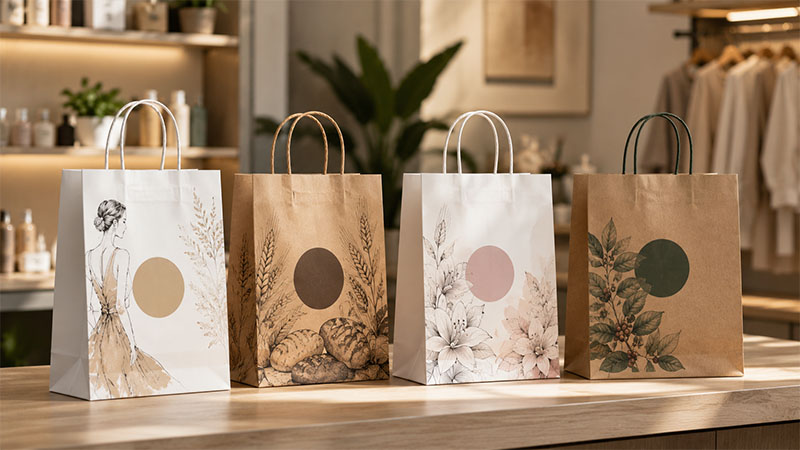
Custom printed paper bags are strong for branding because they give designers a stable surface.
The panels are usually flatter and more structured than plastic bags. That makes artwork easier to place and easier to read. Logos, illustrations, patterns, QR codes, slogans, and product messages can sit cleanly on the front, back, or side gussets.
Paper also gives brands more visual personality.
Brown kraft paper can feel natural and handmade. White kraft paper can feel clean and modern. Coated paper can feel premium and polished. Textured paper can feel boutique. Food-grade paper can feel practical and trustworthy.
That material choice already tells a story before the ink even arrives.
Then we add printing.
Paper bags can support simple one-color logos, full-color artwork, large brand patterns, seasonal illustrations, and detailed graphics. With the right paper and printing method, custom printed paper bags can look like part of a complete brand system.
This is why paper bags are popular for fashion, cosmetics, bakery, coffee, gifts, restaurants, trade shows, and premium retail.
They do not just hold products.
They introduce them.
How Do Custom Printed Plastic Bags Support Branding?
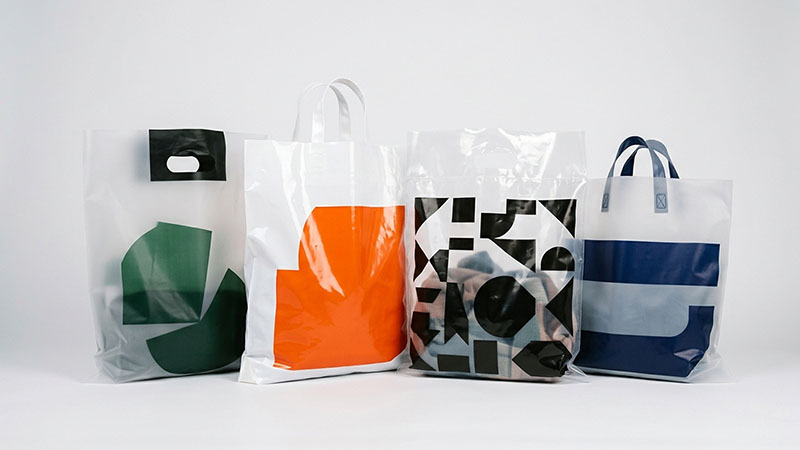
Custom printed plastic bags can also support branding, especially when the design is simple and bold.
Plastic bags are often used for supermarkets, apparel stores, convenience retail, promotional giveaways, courier packaging, and lightweight product packaging. They can be printed with logos, slogans, icons, patterns, and basic brand colors.
Plastic surfaces can look glossy, matte, transparent, frosted, or colored. This gives brands some visual choices.
For example, a frosted plastic bag with a simple logo can look modern. A clear plastic bag can show the product inside. A bright colored plastic bag can support event promotions or seasonal campaigns.
But plastic has limitations.
It is flexible and can wrinkle. The printed image may distort when the bag is filled, stretched, or folded. Fine text and detailed artwork may not look as stable as they do on paper.
Also, plastic bag printing often works best with simpler designs. Large flat colors, bold logos, and clear patterns are usually safer than delicate illustrations or complex gradients.
So I see plastic bags as useful for direct branding.
Paper bags are better for expressive branding.
One says, “Here is our logo.”
The other can say, “Welcome to our little universe.”
Which Material Offers More Paper Bag Customization Options?
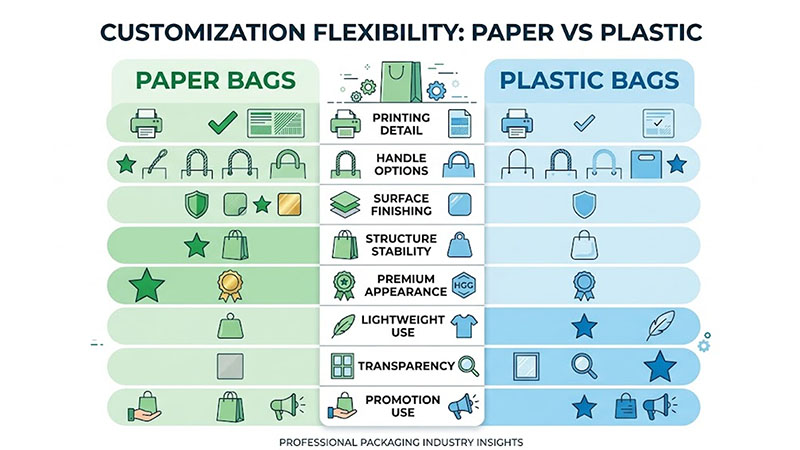
Paper bags usually offer more customization options for structure and finishing.
That is one of their biggest advantages.
With paper, we can customize:
- Μέγεθος τσάντας
- Paper material
- Paper thickness
- Handle type
- Κάτω δομή
- Side gusset width
- Printing colors
- Full-surface artwork
- Σημειακή υπεριώδης ακτινοβολία (UV)
- Embossing
- Debossing
- Σφράγιση με αλουμινόχαρτο
- Matte lamination
- Gloss lamination
- Soft-touch coating
- Die-cut windows
- Inner printing
- Reinforced top fold
- Reinforced bottom card
- Λαβές κορδέλας
- Cotton handles
- Στριμμένες λαβές χαρτιού
- Επίπεδες λαβές χαρτιού
This gives brands many ways to create a specific look and feel.
A luxury cosmetics brand may choose white paper, matte lamination, gold foil, and cotton handles.
A bakery may choose kraft paper, one-color illustration, and twisted paper handles.
A trade show gift bag may choose full-color printing, reinforced handles, and a large side gusset.
A takeaway food brand may choose grease-resistant paper, simple printing, and flat handles.
Paper lets the bag become part of the brand experience.
Plastic can be customized too, but mostly around film type, thickness, color, handle cut, print design, and surface effect. That can be enough for some brands. But if the goal is premium presentation, paper gives more tools.
And in branding, tools matter.
A chef can cook with one pan. But give the chef a full kitchen, and suddenly dinner has a personality.
What Plastic Bag Customization Options Are Available?
Plastic bag customization options are more limited than paper, but still useful.
Brands can customize:
- Μέγεθος τσάντας
- Film thickness
- Film color
- Διαφάνεια
- Frosted finish
- Glossy finish
- Matte finish
- Handle cut
- Die-cut handle
- Patch handle
- Drawstring style
- Zipper or resealable closure
- Logo printing
- Pattern printing
- Warning text
- Basic product information
- Courier bag adhesive strip
Plastic bags can be a good fit when the brand needs lightweight packaging, simple promotional bags, or packaging that shows the product inside.
For example, a clothing retailer may use a frosted plastic bag with a black logo. A courier brand may use printed plastic mailers with a peel-and-seal strip. A promotional event may use colorful plastic bags with a sponsor logo.
However, plastic does not usually support the same premium finishing range as paper. Embossing, foil stamping, textured paper effects, and structured handles are more natural on paper bags.
Plastic can look clean.
Paper can look crafted.
That is the difference I see most often.
Which Bag Is Better for Detailed Artwork and Illustrations?
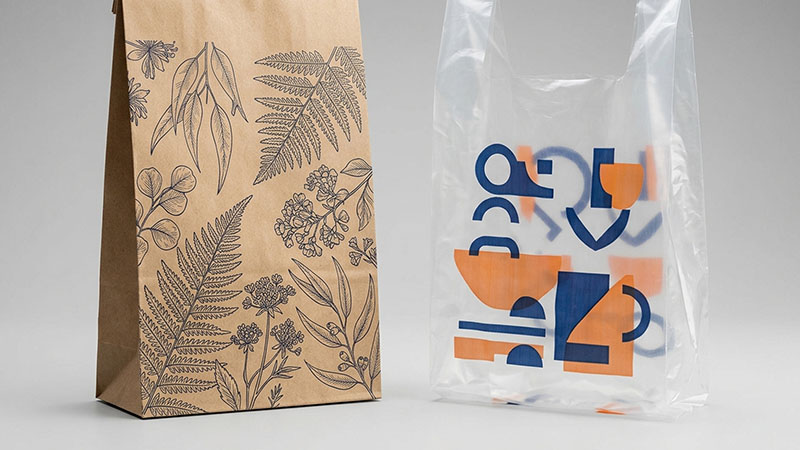
Paper bags are usually better for detailed artwork and illustrations.
The reason is simple. Paper gives a more stable printing surface.
If a brand wants custom illustrations, fine line drawings, food sketches, maps, characters, decorative borders, or detailed patterns, paper is often the safer choice.
White paper can show colors clearly. Kraft paper can give illustrations a natural, handmade feeling. Coated paper can support sharp details and rich colors.
Plastic can print artwork too, but fine details may suffer when the bag stretches, wrinkles, or reflects light. Some plastic films also create glare, which can reduce readability.
If the artwork includes tiny text, thin lines, subtle shadows, or complex gradients, we need to be careful with plastic.
For paper, we still need proper file preparation. The artwork should be high resolution, usually 300 DPI for raster images, or vector format for line art and logos. CMYK color mode is preferred for print preparation. Bleed and safe areas are important.
A design that looks perfect on a laptop can become a small tragedy on the wrong material.
And I prefer my tragedies in movies, not production orders.
Which Bag Is Better for Color Customization?
Both paper and plastic bags can support color customization, but the results are different.
Paper gives more natural color expression, especially when brands choose the right paper base.
White paper is best for bright and accurate colors. Brown kraft paper gives a warm and natural tone, but colors may appear darker. Coated paper can support stronger saturation and sharper contrast.
Plastic bags can also use colored film or printed colors. Glossy plastic can make colors look bright. Frosted plastic can make colors softer. Transparent plastic can create layered effects when the product is visible inside.
However, color consistency can be more challenging on plastic depending on the film type, ink system, and production process.
For paper bags, we can use Pantone references, CMYK printing, color proofs, and sample checks. For strict brand colors, physical proofing is important.
I always tell buyers: do not approve color only from a screen.
Screens lie.
Some screens lie politely. Some screens lie like a sales brochure written at midnight.
If brand color accuracy matters, ask for proofing and confirm the paper material before mass production.
Which Bag Is Better for Premium Surface Finishing?
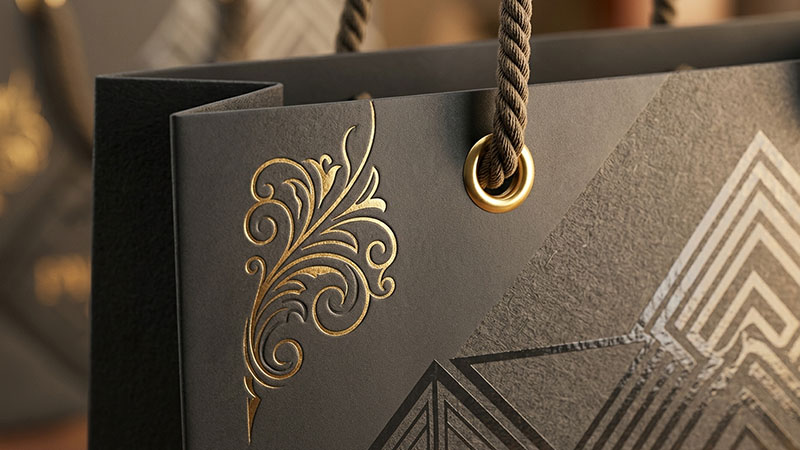
Paper bags are much better for premium surface finishing.
This is where paper becomes very strong.
Paper can support foil stamping, embossing, debossing, spot UV, matte lamination, gloss lamination, soft-touch coating, textured paper, metallic ink, and die-cut windows.
These finishes create a tactile and visual experience. Customers can see and feel the difference.
A foil logo can make a cosmetics bag feel premium. Embossed artwork can make a gift bag feel elegant. Matte lamination can make a fashion bag feel modern. A die-cut window can show bakery products or gift items.
Plastic can have surface effects too, such as gloss, matte, frosted, or transparent film. But it does not usually offer the same luxury finishing depth.
This matters for brands that sell higher-value products.
If the product is premium, the bag should not look like it borrowed clothes from a discount bin.
Which Bag Gives More Handle and Structure Choices?
Paper bags offer more handle and structure choices.
This is another major advantage for customization.
Paper bag handle options include twisted paper handles, flat paper handles, rope handles, cotton handles, ribbon handles, die-cut handles, and reinforced handles.
The structure can also be customized. Brands can choose square-bottom bags, flat-bottom bags, handheld shopping bags, takeaway bags, food bags, and courier paper bags.
Side gussets can be adjusted. Bottom width can be adjusted. Top folding can be reinforced. Bottom cards can be added for heavier products.
Plastic bags also have handle options, such as die-cut handles, patch handles, loop handles, drawstring handles, and soft handles. But the structure usually remains more flexible and less premium.
Paper bags can stand upright.
Plastic bags usually collapse.
That sounds like a small detail until you put the bag on a retail counter, inside a gift set, or in a product photo.
A standing bag behaves like packaging.
A collapsing bag behaves like laundry.
Which Bag Works Better for Food Brand Customization?
For food brand customization, paper bags often provide stronger brand presentation.
This is especially true for bakeries, coffee shops, takeaway restaurants, organic food brands, snack brands, and food gift packaging.
Paper bags can be printed with food illustrations, ingredient stories, QR codes, nutrition links, flavor icons, or seasonal designs. Kraft paper can create a natural food feeling. White paper can support clean and colorful branding.
Food paper bags can also be customized with grease-resistant coatings, windows, flat bottoms, square bottoms, and takeaway handles.
Plastic bags may be useful for certain food applications, especially when moisture resistance or product visibility is needed. But for brand storytelling and warm customer experience, paper usually feels more suitable.
A croissant in a kraft paper bag feels charming.
A croissant in a plastic bag feels like it is being held for questioning.
Of course, food contact requirements matter. Brands should confirm materials, inks, coatings, and certifications before production.
Which Bag Works Better for Retail Promotions?
Both paper and plastic bags can work for retail promotions, but they serve different goals.
Plastic bags are useful for simple, high-volume promotions. They can carry bold logos, campaign slogans, event colors, and sponsor messages. If the goal is quick distribution, plastic may be practical.
Paper bags are better when the promotion needs stronger brand experience.
For example, a pop-up store, product launch, trade show gift bag, cosmetics campaign, or holiday retail event can benefit from custom printed paper bags. The bag can include artwork, QR codes, coupons, special finishes, or limited-edition designs.
Paper bags also photograph better in many retail settings. They stand upright, show the logo clearly, and feel more gift-like.
That matters when customers post unboxing photos or event pictures.
A promotional bag should not just carry free samples. It should carry the campaign.
Otherwise, it is just a handle with expenses attached.
How Do MOQs Affect Paper vs Plastic Bags Customization?
Minimum order quantity, or MOQ, affects both paper and plastic bag customization.
For custom printed paper bags, MOQ depends on bag type, size, material, printing colors, finishing, and production setup. More complex customization usually requires a higher MOQ.
For custom printed plastic bags, MOQ also depends on film type, printing method, thickness, color, and bag structure. Plastic printing may require larger runs for cost-effective production, especially with custom film colors or multi-color printing.
In general, simple printing has more flexible MOQ than complex finishing.
A one-color logo is easier to produce than a full-color illustration with foil stamping and special handles.
This is true for both paper and plastic.
For B2B buyers, MOQ should not be judged alone. It should be connected to the brand goal, inventory plan, promotion schedule, and logistics timeline.
A lower MOQ sounds nice until the unit price becomes rude.
A higher MOQ sounds scary until the campaign volume makes sense.
This is why we always ask about the project purpose before quoting. Packaging is not only a product. It is a supply chain decision wearing a nice outfit.
What Artwork File Requirements Should Buyers Prepare?
Artwork file preparation is important for both paper and plastic bags.
For custom printed paper bags, we usually prefer vector files such as AI, PDF, or EPS. For raster images, high-resolution files are needed. CMYK color mode is recommended. Fonts should be outlined. Bleed and safe areas should be included.
For custom printed plastic bags, vector files are also preferred. Large solid graphics and simple line art usually print better. Fine gradients, small text, and delicate details should be tested carefully.
Buyers should prepare:
- Final logo files
- Illustration or pattern files
- Pantone color codes if needed
- Μέγεθος τσάντας
- Dieline or layout request
- Printing position
- Handle preference
- Material preference
- Quantity
- Destination country
- Certification needs
- Delivery deadline
If the buyer does not have a dieline, the manufacturer can usually provide one after confirming the bag size and structure.
At GreenWing, we help review artwork before production. This is important because one small file issue can become thousands of wrong bags.
And thousands of wrong bags do not quietly disappear. They sit in a warehouse and judge everyone.
How Should Brands Choose Between Paper and Plastic for Customization?
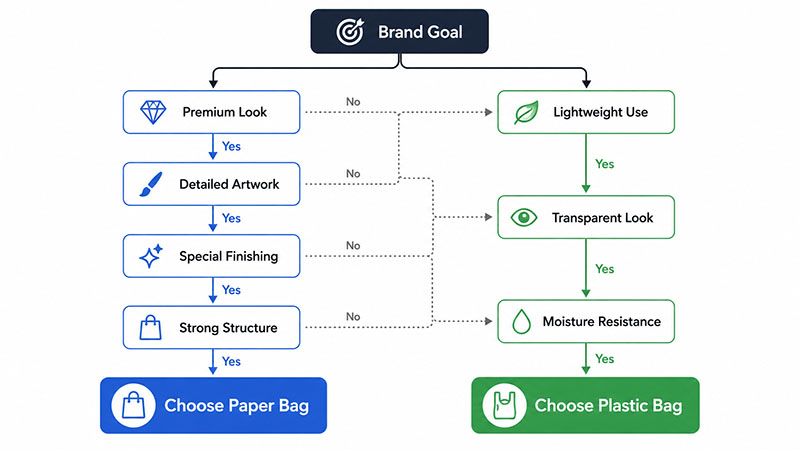
Brands should choose based on the customization goal.
Choose paper bags if you need:
- Premium brand presentation
- Detailed artwork
- Strong structure
- Multiple handle options
- Special finishing
- Food or retail storytelling
- Gift-like customer experience
- Better display on counters or shelves
- More tactile packaging
Choose plastic bags if you need:
- Simple logo printing
- Lightweight packaging
- Transparent or frosted appearance
- Basic promotional use
- Flexible packaging
- Moisture-resistant presentation
- High-volume simple retail bags
This article is focused on customization, so I will not turn it into a full debate about cost, sustainability, or strength. Those topics deserve their own boxing ring.
For branding flexibility, paper usually gives more creative control.
For simple and practical customization, plastic can still work.
The best decision depends on what your customer should feel when they receive the product.
If the answer is “premium,” “crafted,” “warm,” “gift-like,” or “memorable,” paper is usually my recommendation.
If the answer is “simple,” “lightweight,” “transparent,” or “basic promotion,” plastic may be enough.
How Does GreenWing Support Paper Bag Customization?
At GreenWing, we focus on wholesale paper bag manufacturing.
We produce handheld paper bags, square-bottom paper bags, flat-bottom paper bags, courier paper bags, food packaging bags, and takeaway packaging. We support custom printing, material selection, size adjustment, handle options, finishing, sampling, inspection, and export coordination.
Since 2008, we have built a 50,000 square meter production facility, a 20,000 square meter warehouse, over 100 advanced machines, and a team of more than 300 staff. Our daily output reaches around 5 million bags. We also hold over 40 national patents and 60 qualifications and honors.
That scale matters for B2B buyers.
But flexibility matters too.
A buyer may need kraft takeaway bags for a food brand. Another may need white retail bags with full-color artwork. Another may need square-bottom bags with strong handles and seasonal printing.
Our job is to help buyers turn brand ideas into printable, practical, export-ready paper bags.
We cannot make every design cheaper, faster, and more complicated at the same time. I am a manufacturer, not a magician with a forklift.
But we can help choose the right structure, printing method, material, and production plan.
That is where good customization becomes good business.
What Questions Should Buyers Ask Before Ordering?
Before ordering custom printed paper bags or custom printed plastic bags, buyers should ask clear questions.
Here are the questions I recommend:
- What brand feeling should the bag create?
- Is the artwork simple or detailed?
- Do we need exact brand color matching?
- Will the bag be used for retail, food, events, or delivery?
- Does the bag need to stand upright?
- What handle style fits the product?
- Do we need premium finishing?
- What is the target order quantity?
- What is the delivery deadline?
- Are certifications required?
- Do we need food contact materials?
- Will customers reuse or photograph the bag?
- Does the design need QR codes or campaign messages?
- Is the artwork ready for printing?
These questions help avoid confusion between buyer, designer, and manufacturer.
Most packaging problems do not begin on the machine.
They begin in unclear emails.
I say this as someone who has read many unclear emails and aged spiritually from them.
συμπέρασμα
For customization and branding, paper bags usually offer more creative flexibility than plastic bags. They support detailed artwork, premium finishes, stronger structures, and more handle choices. Plastic bags still work for simple, lightweight, and promotional needs. At GreenWing, we help brands build custom paper bags that look good and produce reliably.